Wet Belt Grinder: Why Water-Cooled Grinding Wins (2026)
Wet Belt Grinder: Why Water-Cooled Grinding Wins (2026)
November 17, 2026
Luo Haibo serves as core technical director and primary patent inventor at Qianma Technology, the original manufacturer of automatic polishing machines. He possesses decades‑long hands‑on expertise in metal‑surface polishing and consumable matching, leading R&D for polishing‑machine mechanical structures and process optimization. As the official export brand, Yiliang Polishing (operated by Guangzhou Yiliang Trading Co., Ltd.) delivers global market services and full‑range polishing consumables. Jointly we provide factory‑direct one‑stop metal‑surface finishing solutions for worldwide manufacturing clients.
Luo Haibo – CEO, Yiliang Polishing
A wet belt grinder cools the cut, keeps the belt sharp and holds a flat reference that dry sanding cannot. When to choose one, and how to specify it.
By Yiliang Polishing Engineering Team · Updated November 2, 2026 · 14 min read
Quick Answer
A wet belt grinder (also called a wet belt sander or water-cooled belt grinder) runs an abrasive belt over a water-flooded platen so that coolant reaches the contact point with the belt. Water does four jobs at once: it removes heat, flushes swarf out of the grit, lubricates the scratch and captures dust instead of releasing it. Choose wet over dry when your part is thin, heat-sensitive or tolerance-critical, when you grind aluminium, magnesium or titanium and cannot risk airborne combustible dust, or when you need a consistent flat reference for deburring and parting lines. Choose dry when you are removing heavy stock from thick, forgiving parts and floor space or budget is the deciding constraint.
Most finishing shops meet the wet belt grinder the hard way: a batch of thin stainless panels comes back with a blue heat tint along the edge, or a run of aluminium castings triggers a dust inspection, and suddenly the dry sander that has worked for a decade is the problem. Water is the usual answer — but water is also the reason a wet machine costs more, needs more maintenance and behaves differently from the dry machine beside it.
This guide is written from the order files rather than from a brochure. The specifications and price bands quoted below come from real quotations and order confirmations issued between 2023 and 2026 for customers in jewellery, fluid fittings, cutlery, brake components, tube and hardware — and from the machine manuals we ship with each unit.
1. What a wet belt grinder actually is
Definition
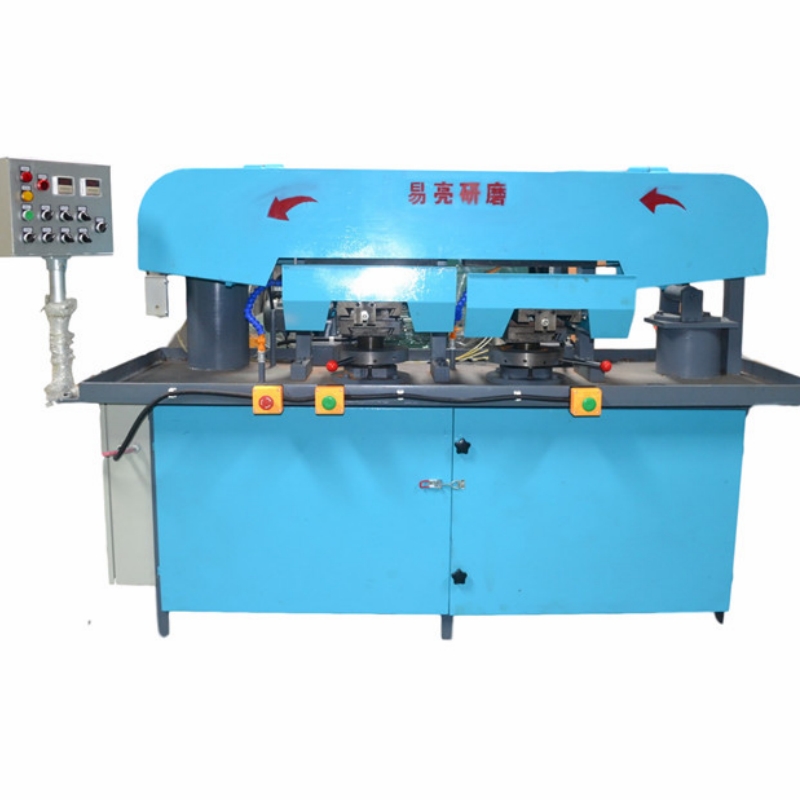
A wet belt grinder is a belt sanding machine in which the abrasive belt passes over a water-cooled or water-flooded platen and through a recirculating coolant system — pump, tank, filter and settling zone — so that the contact zone between belt and workpiece is continuously wetted. The workpiece is clamped in a fixture on a worktable that feeds or oscillates against the belt. It is used for flat surface grinding, deburring, parting-line removal and satin or hairline finishing, most often on stainless steel, aluminium, brass, glass, ceramics and jewellery alloys.
The critical detail is where the water goes. On a cheap "wet" machine the water dribbles onto the worktable and the belt runs mostly dry. On a properly built machine the platen itself is flooded, the belt carries a film of coolant into the nip, and the swarf leaves the cut as a slurry rather than as airborne dust. That distinction explains almost every difference in finish quality and belt life between one wet machine and another.
The second critical detail is the hard platen. Unlike a contact wheel, which produces a soft, following cut, a flat steel platen gives the belt a rigid backing. That is what allows a wet belt machine to hold a flatness figure instead of merely smoothing a surface — in the manual for our single-head YL-ATPM-056, the quoted plane grinding accuracy is ±0.05 mm.
2. The four jobs water does
Water is not a coolant additive to a dry process; it is a process variable. Each of its four functions solves a different production problem.
Cooling — protecting the metallurgy, not just the operator
Dry belt sanding concentrates a large amount of energy into a very small contact patch. On thin sheet, the edge reaches tempering temperature in a fraction of a second, which is why dry-ground stainless shows straw, brown and blue oxide bands. Those bands are not cosmetic: they are a visible record of a metallurgical change, and on hardened or spring-tempered parts they mean lost hardness and a risk of micro-cracking. Flooding the platen keeps the workpiece near ambient, so the temper, the flatness and the colour all survive the operation.
Flushing — keeping the grit sharp
Metal swarf is the enemy of an abrasive belt. When particles pack into the grain, the belt stops cutting and starts burnishing; the operator leans harder, heat climbs, and the belt glazes. Water carries the swarf away from the grain continuously. In practice this is the single largest contributor to belt life on non-ferrous work, and it is why a wet machine often consumes fewer belts per tonne of aluminium than the dry machine it replaced.
Lubrication — a shallower, cleaner scratch
Water lowers friction between the grain and the workpiece. A lower-friction cut produces a shallower scratch at the same pressure, which means you can reach a given surface finish one grit step earlier. For a shop finishing to a hairline or satin appearance, that translates into one less pass over every part.
Dust containment — the safety argument
This is the function that increasingly decides the purchase. Grinding aluminium, magnesium, titanium and some zinc alloys dry produces fine, reactive dust; the fines settle on ledges, in ducts and on rafters, and a combustible-dust incident is a genuine industrial hazard rather than a theoretical one. Wet grinding moves that dust into a water tank as sludge. If you must grind dry, you need engineered extraction — which is why we also build explosion-proof wet dust treatment equipment and stock an explosion-proof dust collector range. Our guide to preventing combustible dust explosions covers the risk assessment in detail.
The counter-intuitive bit
Wet grinding does not produce a finer finish than dry grinding because the abrasive is finer — it uses the same belt. It produces a finer finish because the belt stays sharp, the pressure stays low and the swarf leaves the cut. A worn, loaded belt on a wet machine will still scratch. Water protects the belt; it does not substitute for changing it.
3. Wet vs dry: a decision table
Neither process wins outright. The honest comparison is a list of trades, and the right answer depends on which trade your parts cannot afford.
Criterion
Dry belt sander
Wet belt grinder
Heat at the cut
High; heat tint and temper loss on thin or hardened parts
Low; workpiece stays near ambient
Dimensional accuracy
Good on heavy parts, drifts on thin ones as heat moves the metal
Holds a flat reference; quoted at ±0.05 mm on our YL-ATPM-056
Machine plus tank; no ducting, but water and drainage
Corrosion risk
None from the process
Ferrous parts need drying or an inhibitor
Maintenance load
Filter and duct cleaning
Tank cleaning, coolant top-up, sludge disposal, pump care
Capital cost
Lower for the same belt width
Higher — pump, tank, stainless splash guarding
Best fit
Thick, forgiving parts; heavy stock removal; wood and paint
Thin, precise or heat-sensitive parts; non-ferrous; deburring to a radius
Two practical rules follow from the table. First, if your reject rate is driven by heat tint, warping or an inconsistent burr radius, wet is not an upgrade — it is the fix. Second, if your parts are thick, your tolerances are loose and your only complaint is throughput, a dry machine with better extraction will usually be the cheaper route, and there is no reason to take on coolant maintenance.
4. Anatomy of the machine
Once you have decided on wet, the specification question becomes concrete. A wet belt grinder is built from seven subsystems, and each one is a decision you will live with for a decade.
Belt and pulley set
Belt length and width set the maximum part footprint and the heat the belt can shed. A 3000 × 100 mm belt on a single-head machine, and a 4000 × 100 mm belt on a dual-station machine, is the pattern across our range. Drive wheel diameter (10 inch rubber is typical) sets belt speed and grip.
Platen and pressure plate
The hardened plate behind the belt is the accuracy reference. Its flatness, hardness and width decide how square an edge you can produce and how evenly a burr breaks. On our machines the belt pressure plate is cast steel for wear life, and its size is customisable.
Worktable and carriage
The table carries the fixture and feeds the part into the belt. Table size is quoted per part — 200 × 100 mm is a common standard, with larger or taller tables built to order. The carriage may oscillate, typically around 100 strokes per minute, to break up the scratch pattern.
Coolant circuit
Pump, tank, filter and splash guarding. Tank volume is the buffer that keeps temperature stable; a small tank heats up within an hour and stops cooling effectively. Filtration is what decides whether the pump survives.
Drive and control
Main motor plus an oscillation motor. Options run from a simple push-button panel to a servo-fed CNC axis that controls part thickness pass by pass — our YL-ATPM-066 adds a 1.2 kW servo to the same 7.5 kW head for exactly that reason.
Fixture
Cut to the contour of your part and mounted on the table. On hard, flat parts this is a clamp; on jewellery, watch parts or castings it is often the difference between a process that repeats and one that does not.
Guarding and safety
Water plus a spinning belt means splash, slip and electrical risk. Waterproof electrical enclosures, an emergency stop at the operator position and a splash guard that actually contains the spray are non-negotiable.
5. The wet belt sander range and real specs
The four configurations below cover almost every request we receive, from a single bench machine in a jewellery workshop to a rotary table cell inside a die-casting plant. Specifications are taken from our machine manuals and issued quotations. Full product pages sit in the wet belt sander category.
All models: 380 V / 50 Hz standard, other voltages to order. Worktable, platen and fixture dimensions are built to the workpiece.
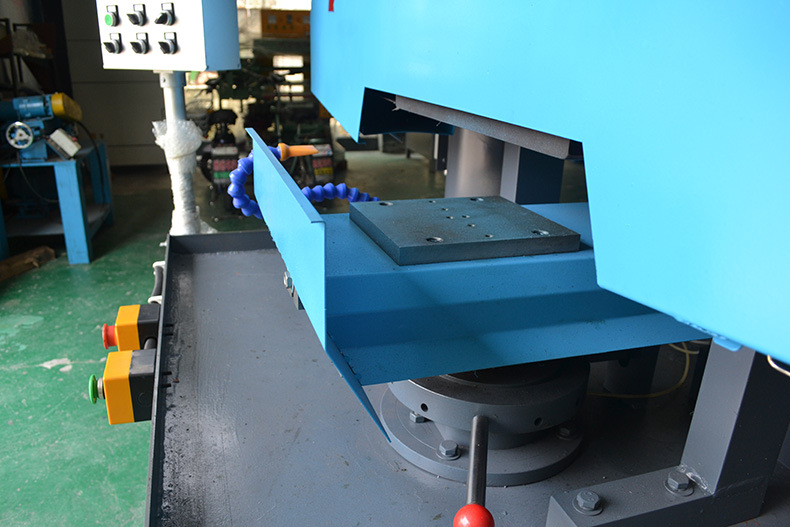
Two further specifications matter more than they look. Maximum enclosed height — on one compact single-head build we quoted in 2026, 50 mm from the spray plate to the belt plate with the carriage fully lowered — determines how tall a part you can pass under the head, and it is the number most often got wrong when a customer specifies from a photo. Belt speed, quoted at 13 m/s on the same build, sets the balance between cut rate and heat: faster removes stock quicker but leaves less time for coolant to work.
The belt is the cheapest component on the machine and the one that decides the result. Two choices are being made at once: the grain and the grit.
Grain
Best on
Behaviour
Watch out for
Zirconia alumina
Stainless steel, carbon steel, hard alloys
Fractures under pressure and keeps exposing fresh edges; long life at moderate pressure
Overkill — and overpriced — on soft alloys
Silicon carbide
Aluminium, brass, glass, stone, ceramics
Sharp, friable, cuts cool
Shorter life on steel; can embed in soft metals if pressure is too high
Aluminium oxide
Mild steel, general deburring, wood
Economical, predictable
Glazes quickly on stainless
Ceramic
High-pressure stock removal on hard steel
Highest cut rate and life
Needs pressure to self-sharpen; wasted on light finishing
Grit should be treated as a ladder, not a single purchase. In our own quotations, the 120 grit zirconia belt in 4000 × 100 mm is the workhorse consumable: one jewellery and hardware customer has reordered it in lots of 100 to 200 belts several times a year since 2024, at around RMB 41 per belt for zirconia and RMB 18 for the silicon carbide equivalent in the same size. That price gap is the whole grain argument in one line — the silicon carbide belt is less than half the price and lasts less than half as long on stainless.
Grit
Job
Typical use
80 – 120
Stock removal, deburring, parting lines
First pass on castings, laser-cut edges, weld-adjacent metal
150 – 180
Levelling, removing the previous scratch
Second pass; establishing flatness before finishing
240 – 320
Satin / hairline preparation
Stainless panels, hardware, watch cases
400 +
Pre-polish
Hand-off to a buffing wheel and compound
Rule of thumb: never jump more than one doubling of grit. 120 to 240 works; 120 to 400 leaves scratches the polisher cannot remove.
Belt construction matters as much as grain in a wet process. The backing must be waterproof and the bond resin — a belt made for dry use will delaminate at the joint once it runs wet. Joint type also matters: a lap joint is stronger but leaves a periodic mark, a butt joint runs flatter and is preferred for finishing passes. If you are moving from dry to wet, do not carry your old belt stock across; specify wet-rated belts from the start. Our polishing consumables range covers belts by length, width and grit, and we can cut custom sizes.
7. Platen, fixture, and where the accuracy comes from
Customers often ask for a machine that "holds ±0.05 mm" as though it were a property of the frame. It is not. Accuracy comes from the interaction of three things: a flat, hard platen; a rigid fixture that holds the part at a repeatable attitude; and a table feed that does not deflect under load.
The fixture is where most projects are won or lost. A flat plate with a clamp works for a flat plate. A watch case, a lock panel, a glass door clip, a floor drain cover or a piece of jewellery needs a nest cut to its contour, so that the part sits in the same attitude every cycle and the operator cannot load it upside down or at an angle. In the manual for the YL-ATPM-056 we list exactly this group of parts — tools, lock panels, glass door clamps, watch straps, floor drains, ceramics and handicraft items — because each one needs its own nest rather than a generic clamp.
Two details are worth insisting on in the specification. First, a pneumatic table lift rather than a manual screw: it returns to the same height every cycle and removes the operator's judgement from the process. Second, oscillation: a table that swings in and out during grinding breaks up the straight-line scratch pattern, which is why a wet belt finish reads as an even satin rather than a set of parallel grooves. Our manual describes the swing as "mutual offset of the lines" — the same principle a hand polisher uses when changing direction between passes.
If thickness is the controlled dimension rather than flatness, the CNC variant is the right answer. The YL-ATPM-066 adds a 1.2 kW servo axis so that every part is brought to the same thickness pass after pass, which is precisely the requirement when a belt machine is used to size a stamped or cast part rather than simply to clean it.
8. Coolant and water management
Every wet machine eventually fails for the same reason: the water was neglected. Coolant is a process input with a maintenance schedule, and the shops that get years of trouble-free service from a wet belt grinder are the ones that treat the tank as a controlled system.
Filtration before volume. A settling tank with baffles plus a mesh or cartridge filter keeps grit out of the pump. Pump wear from abrasive slurry is the most common failure we see in the field.
Tank volume buys stability. A larger tank heats more slowly and holds concentration better. On a machine running all day, tank size matters more than pump power.
Corrosion inhibition for ferrous work. Water alone offers no protection. A small dose of a corrosion inhibitor in the coolant, plus an air blow-off at the exit, keeps carbon and mild steel parts from flash-rusting between grinding and the next process.
Change on a schedule, not on smell. Sludge accumulates, bacteria follow, and a rancid tank is both a health issue and a finish defect. Skim sludge, top up with clean water, and change on a fixed interval.
Plan the sludge. Metal-bearing sludge is a waste stream with disposal rules in most jurisdictions. Know where it goes before you buy the machine, not after.
Respect frost. In an unheated workshop, a water circuit left full over a cold weekend can crack a pump housing or a tank fitting. Drain-down or frost protection is part of the installation, not an afterthought.
A cheap decision that pays back fast
Specify the largest tank that fits the footprint, and a filter you can clean in two minutes without tools. Operators clean what is easy to clean. A tank that takes twenty minutes to open will be opened approximately never, and the pump will pay for that.
9. How one operator runs three machines
Wet belt grinding is a machine-tended process with a short cycle, which changes the labour model. The machine does not need an operator's hands on the part — it needs a load, a cycle, an unload. That is why the standard configuration on our single-head machines is one operator to two or three machines: he loads machine one, starts it, loads machine two while one is cutting, and unloads in sequence.
The dual-station machine changes that arithmetic. Because each station has its own 7.5 kW head, a dual-station unit is normally run with one operator per machine rather than one operator across several, and the productivity gain comes from eliminating the load/unload dead time inside a single machine instead of from spreading labour across several. Neither layout is better in the abstract; the choice depends on whether you have floor space or people as the scarcer resource.
Cycle time itself is set by the grinding timer, which is configured per product, and by the table feed. On a rotary four-station machine the indexing table does the same job in a different geometry: one station loads while three grind, so the machine effectively never stops. That is the configuration we quoted for a customer grinding small parts where the fixture, not the motor, was the constraint.
10. Wet belt vs. wet wheel: two ways to flood a line
"Wet" is not one process. A wet belt machine floods a flat platen; a wet polishing line floods buffing wheels. They answer different questions and are often used in sequence.
On the belt side you get flatness, edge break and a controlled scratch — the geometry work. On the wheel side you get gloss, because a cloth or sisal wheel with compound can reach a brightness no abrasive belt will produce. A typical stainless part therefore runs: wet belt at 120 to 180 grit to flatten and deburr, wet belt at 240 to 320 to prepare, then buffing wheels with compound to finish. The compound side of that sequence is covered in our polishing compound guide, and the wheel side in how to choose the right polishing wheel.
For high-volume tube work, the whole sequence can be built as one wet line. In a 2023 configuration document for a 16 mm to 130 mm tube polishing project, we quoted a ten-head round tube polishing machine in a water-polishing build: the QM-DSYP10-63 covering Φ16 to Φ63 mm at RMB 135,000, and the QM-DSYP10-133 covering Φ51 to Φ133 mm at RMB 168,000, with an automatic loader at RMB 38,000 and an automatic unloader at RMB 37,000 as options. The ten heads carried 55 kW of grinding motors plus a 3.7 kW main drive — 58.7 kW total — handling tube lengths of 4000 to 6000 mm at a feed rate adjustable from 0 to 60 m/min.
That machine is the answer when the part is long, round and uniform. The flat-platen belt machine is the answer when the part is short, flat, precise and varies. Most plants end up with both.
11. What our order files show
Specifications are easy to list and hard to trust. The more useful evidence is what customers actually bought, because each order encodes a set of compromises that were accepted in the real world.
Year
Customer / application
Configuration
Indicative price
2023
Jewellery & hardware (Yiwu)
Dual-head automatic wet belt machine, 4000 × 100 mm belt
RMB 45,000 ex-works
2024
Fluid fittings manufacturer (Kunshan)
Single-head wet belt machine, 7.5 kW, 3000 × 100 mm, taller 150 mm table
RMB 33,500 + 13% VAT
2024
Jewellery & accessories
Dual-head (RMB 47,000) + single-head (RMB 34,800) as a pair
RMB 81,800 combined
2024
Small-parts grinding cell
Four-station rotary wet belt machine, 150 × 3000 mm belt, pneumatic platen
RMB 58,800 incl. one fixture set
2023
Brake component manufacturer
Wet line: 3 kW conveyor, two 3-wheel heads, two VFDs, water circulation with pump, tank and filter, PLC, six sensors, waterproof cabinet
RMB 97,300
2026
Indian distributor (repeat quotation)
Compact single-head wet belt machine, 7.5 kW, 13 m/s belt speed, 50 mm max enclosed height
USD 4,280 incl. export crate
Indicative historical reference only, drawn from our own 2023–2026 quotations and order confirmations. Prices are not current offers; specification, freight and currency will change the figure.
Three patterns are worth reading out of that table. First, the single-head machine is the volume product: most buyers start with one, and a substantial share come back for a second rather than trading up to a dual-station unit. Second, the dual-station machine is bought by customers who already know their cycle time and have calculated the labour saving — it is rarely a first purchase. Third, the bespoke line is a different category entirely: the brake-pad project at RMB 97,300 was not a belt machine with options, it was an engineered conveyor line with a three-wheel polishing head at each of two stations, and it was priced accordingly.
The consumable pattern is equally informative. The jewellery and hardware customer mentioned earlier has ordered 4000 × 100 mm 120 grit belts repeatedly since 2023 — 100 silicon carbide and 200 zirconia in a single 2024 order, 200 zirconia at the end of 2025, 120 in mid-2026, and 100 more in September 2026. That cadence, roughly one belt lot every few months, is what a working wet process looks like from the supply side. It also tells you something practical about budgeting: the machine is a one-off cost, the belts are a subscription.
Before you request a quotation, answer these eight questions. A supplier who asks them is a supplier who has built a wet machine before; a supplier who quotes a price without them is selling you a box.
Part envelope. Length, width, height and weight of the largest and smallest part. Height under the head is the specification most often missed.
Material. Stainless, carbon steel, aluminium, brass, zinc alloy, glass, ceramic or jewellery alloy. This decides the grain.
What you are removing. Heat tint, a burr, a parting line, a machining mark, or 0.2 mm of stock. Stock removal drives motor power and grit.
The controlled dimension. Flatness, thickness, edge radius or surface finish — and the tolerance on it.
Required finish and the next process. If a buffing stage follows, the belt only has to prepare, not finish.
Volume and cycle time. Parts per hour, and whether the constraint is the machine, the fixture or the operator.
Site conditions. Voltage and frequency, available floor space, water supply and drainage, ambient temperature in winter.
Labour model. One operator across several single-head machines, or one operator per dual-station machine.
On budget, the honest guidance is to separate three numbers. The machine is the figure in the quotation. The fixtures are usually quoted separately and can be a meaningful fraction of the machine cost on complex parts — several of our own quotations carry the explicit note "excluding fixture cost". The consumables and coolant are a running cost that scales with volume, and the belt price per piece is the number to model, not the belt price per box.
Add the installation items that quotations rarely include: a level floor, water supply and drain, a settling area for sludge, an air supply if the table lift is pneumatic, and a drying or blow-off step if you grind ferrous parts. None of these are large, and all of them are the reason a wet machine sometimes sits idle for a month after delivery.
13. Customisation and OEM
Almost nothing about a wet belt grinder is truly standard, because the part it grinds is not standard. That is an advantage if you specify it deliberately and a source of delay if you do not.
Build to your part · brand to your market
What can be customised — and where OEM fits
Machine customisation is routine for us, not a special project. Consumable customisation is what turns a single machine sale into a branded supply relationship.
Worktable and platen dimensions — built to the workpiece footprint, not to a catalogue size.
Fixture design — a nest cut to your part contour, so every cycle loads identically.
Voltage and frequency — 380 V / 50 Hz standard; other supplies to order.
Control level — from a push-button panel to a servo-fed CNC thickness axis.
Coolant tank capacity and filtration — sized to your shift pattern and maintenance routine.
Machine colour and panel branding — your identity on the machine you resell or deploy.
On the consumable side, abrasive belts are cut to your length, width and grit — one 2024 quotation priced a custom 3000 × 100 mm 120 grit zirconia belt at RMB 47 per belt with a minimum cutting lot of 3 to 6 belts, which makes short custom runs practical. For distributors, we supply private-label packaging across the whole line: abrasive belts, abrasive paper, buffing and sisal wheels, nylon wheels, polishing brushes and polishing compound. An OEM programme built across the full consumable range is worth more than one built on a single SKU, because the customer reorders the whole basket, not one item.
2008Company founded
15+ yrsExport experience
1,000+Clients worldwide
OEM / ODMMachine & consumables
The practical advice for an OEM buyer is to bring the part, not the drawing alone — or both. A wet belt grinder is specified around a physical object: how it sits in a nest, how much of it must not be touched, and what the operator's hands do between cycles. A five-minute video of the current manual process, including the reject, tells us more than a specification sheet.
14. Frequently asked questions
What is the difference between a wet belt grinder and a dry belt sander?
A wet belt grinder runs the abrasive belt over a water-flooded platen, so the coolant is dragged into the contact zone with the belt. A dry sander runs the same belt in air. The water removes heat at the point of cut, flushes swarf out of the grit, lubricates the contact and captures dust instead of releasing it. Dry sanding is faster to set up and cheaper to buy; wet grinding holds tolerances, protects heat-sensitive parts and eliminates airborne metal dust.
What abrasive belt should I use on a wet belt grinder?
Use a waterproof resin-bonded belt, and match the grain to the workpiece. Zirconia alumina is the workhorse for stainless and carbon steel because it fractures and stays sharp under pressure; silicon carbide suits non-ferrous metals, glass, stone and ceramics; aluminium oxide is the economical choice for light deburring and softer alloys; ceramic grain is for high-pressure, high-stock removal. Grit is a ladder, not a single choice: 80 to 120 for stock removal and deburring, 180 to 240 for levelling, 320 to 400 for a satin or pre-polish finish.
Can a wet belt grinder remove burrs and die-casting flash?
Yes, and it is one of the most common uses. A wet belt machine with a hardened platen and a contoured fixture will take a laser-cut edge, a machining burr or a die-casting parting line down to a clean radius in one or two passes. Because the platen is a flat, hard reference, the burr breaks off predictably instead of being folded over. Wet operation also stops the thin edge from overheating and losing its temper.
Does wet grinding cause rust on steel parts?
It can, if wet parts are left standing. Water alone offers no corrosion protection, so ferrous parts should be dried promptly after grinding, and either treated with a rust inhibitor in the coolant or moved to the next process while still damp. A small percentage of a corrosion inhibitor in the tank, plus an air blow-off at the exit, solves the problem in most shops. Stainless, aluminium, brass and glass are far less sensitive.
How much does a wet belt grinder cost?
As an indicative reference from our own 2023 to 2026 quotations, a single-head automatic wet belt machine with a 7.5 kW main motor and a 3000 x 100 mm belt has been quoted between roughly RMB 27,500 and RMB 34,800 (about USD 4,100 EXW) depending on frame size, platen and control package. A dual-station unit with two 7.5 kW motors and a 4000 x 100 mm belt has been quoted at about RMB 47,000, and a four-station rotary wet belt machine at about RMB 58,800 including one fixture set. Fixtures, coolant tank size, voltage and control level all move the number.
Can the machine and the belts be customised, including our own brand?
Yes. Machine-side adjustment covers voltage and frequency, worktable and platen dimensions, fixture design to your part contour, platen hardness, coolant tank capacity, machine colour and your logo on the panel. Consumable-side, abrasive belts can be cut to your length, width and grit, and we supply private-label packaging for distributors, covering belts, abrasive paper, buffing and sisal wheels, nylon wheels and polishing compound so an OEM programme can be built across the whole consumable line rather than one item.
Send us the part. We will spec the belt around it.
Tell us the material, the burr or finish you need to remove, and the tolerance you have to hold. We will recommend the right wet belt configuration — single head, dual station or rotary — design the fixture, quote the machine and send a belt sample for you to test on your own parts.
Yi-Liang Polishing · Guangzhou Qianma Technology Co., Ltd. · 15+ years of export experience · Machines, fixtures and consumables from one source
YL
Yiliang Polishing Engineering Team Written by the engineers at Guangzhou Qianma Technology Co., Ltd. / Yiliang Polishing — specialists in polishing machines, polishing lines and consumables, with more than 20 years of industry experience and a decade of export experience across Asia, Europe, Africa and the Americas. www.yl-polishing.com


 English