Luo Haibo serves as core technical director and primary patent inventor at Qianma Technology, the original manufacturer of automatic polishing machines. He possesses decades‑long hands‑on expertise in metal‑surface polishing and consumable matching, leading R&D for polishing‑machine mechanical structures and process optimization. As the official export brand, Yiliang Polishing (operated by Guangzhou Yiliang Trading Co., Ltd.) delivers global market services and full‑range polishing consumables. Jointly we provide factory‑direct one‑stop metal‑surface finishing solutions for worldwide manufacturing clients.
Luo Haibo – CEO, Yiliang Polishing
Tubes are the one workpiece a hand-polisher never wins: too long to hold, too easy to burn, and judged on a surface that runs the whole length of the bar. Here is how automatic tube polishing machines actually work — and how to specify the heads, wheels and feeding system for round, square and aluminum tube.
By Yiliang Polishing Engineering Team · October 19, 2026 · 12 min read
Quick Answer
A tube polishing machine (also called a pipe polishing machine) feeds a tube lengthwise along a roller conveyor past a series of motor-driven grinding and polishing heads, each carrying a different wheel or abrasive belt, so a rough, medium and mirror stage are completed in one continuous pass without the operator holding the workpiece. Choose one by three variables: the tube (round, square or profiled; diameter or section; length; material), the number of heads (one or two for light sanding, six or more for a true mirror on raw tube), and the finishing method (dry grinding, wet grinding, or a wheel-and-belt combination). A conveyor-type square tube machine such as the YL-APM-077-4 treats all four faces of a square section at once with four heads per stage.
Ask a finishing shop what gives them the most trouble and the answer is almost never a flat panel. It is tube. A flat plate sits still on a table and takes a buffing wheel politely. A six-metre tube does not: it flexes, it rings, it whips, it is impossible to hold at the end of the bar, and the finish has to be uniform over its entire length and around its entire circumference. That is why tube polishing, more than almost any other finishing job, belongs to a machine and not to a pair of hands.
This guide explains how automatic tube polishing machines work, how the round, square and abrasive-belt families differ, how many heads a real mirror finish demands, and how the feeding, wet-grinding and dust systems are chosen. It is written for buyers and process engineers specifying a machine, and it uses the actual configurations we build — from a single-head tube machine to a ten-head line for six-metre hot-rolled stainless steel.
1. What a tube polishing machine actually is
Definition
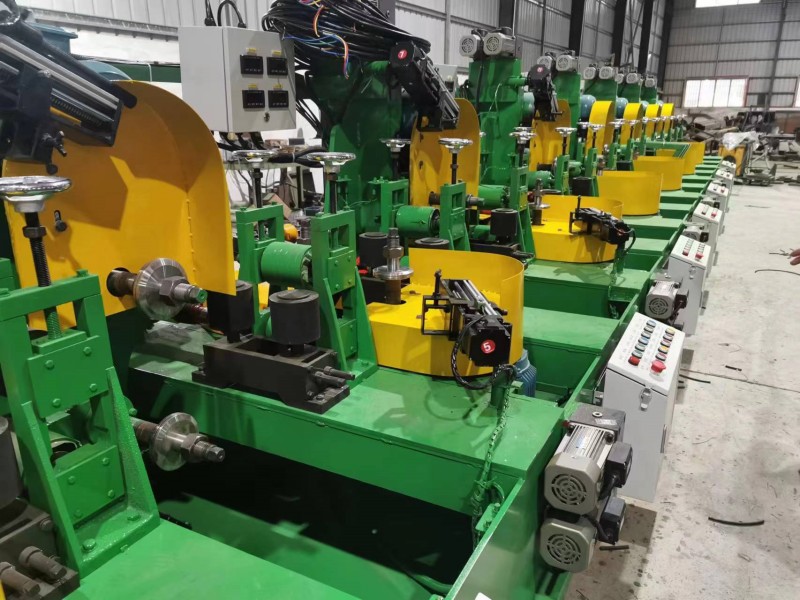
A tube polishing machine is an automatic finishing machine that conveys a round, square or profiled tube lengthwise past a series of motor-driven grinding and polishing heads — each carrying an abrasive belt, a flap wheel, a nylon wheel, a sisal or hemp wheel, or a cloth wheel — to sand, draw or mirror-polish the tube's surface. Because the tube is carried by a roller conveyor rather than held by hand, every head applies the same pressure at the same angle for the same time along the whole length of the bar, which is what makes the finish repeatable from the first tube to the ten-thousandth.
The word "machine" hides a family, not a single product. The same core idea — convey the tube, apply several heads in sequence — is engineered very differently depending on whether the tube is a 16 mm round tube, a 100 mm square section, or a 530 mm steel pipe. What all of them share is the principle that the human hand is replaced by a conveyor and a fixture, exactly as it is in a rotary polishing machine for small parts.
A tube polishing machine is not a flat polishing machine with a longer bed. Four properties of tube force a different design, and understanding them explains almost every feature you will see on the machines.
The tube is long and slender. A six-metre bar of thin-wall tube has very little stiffness; press a wheel against its middle and it bows away. The machine has to support the tube along its length with rollers and feeding racks, and apply the head pressure in a way that does not simply push the tube out of position.
The surface is continuous and curved. A flat panel's finish is judged in the middle; a tube's finish is judged along an unbroken line six metres long and all the way round. Any variation in pressure or wheel wear shows as a band or a spiral, so the conveying speed and head pressure must be held tightly constant.
Tube is rarely perfectly round or perfectly straight. Big drawn or welded pipe has real ovality and bend, so the polishing head cannot be rigidly fixed — it has to float with the surface. This is why our large round-tube machines fit a spring cushioning device on the head, letting the wheel follow the tube's wobble and keep the friction even.
Tube comes in many sections. A round tube is polished by rotating against a wheel; a square tube has four flat faces that must be reached at once; a curved or U-shaped tube cannot be conveyed straight at all and needs a different workpiece-handling concept again. Each of these has its own machine.
The single most common mistake
Buying by tube diameter alone. Two tubes of the same diameter can need completely different machines because one is a short straight round tube and the other is a six-metre square section, or because one starts as smooth cold-rolled stock and the other arrives hot-rolled with deep pits. Diameter is one input; section, length, material and starting finish are the others.
3. The three machine families: round, square, belt
Almost every tube polishing machine we build falls into one of three families. The family decides the head layout and the way the tube is held; the details decide everything else.
Family
Tube it finishes
Head layout
Typical use
Round tube machine
Round tube / pipe, 8–70 mm up to 100–530 mm
Single head to 14 heads in a row, tube rotated as it passes
Sanding, drawing and mirror polishing of round stainless, aluminum and steel tube
Square tube machine
Square / rectangular section, 20×20 to 100×100 mm
Four heads per stage, at top, bottom, left and right
Grinding and polishing all four faces of square tube in one pass
Abrasive belt machine
Round, square and profiled tube; also U-shaped and curved work
One to four belt heads, dry or wet
Grinding, deburring and pre-polish; wet versions for heat-sensitive stock
The families overlap: many round and square machines can be specified with belt heads instead of, or in addition to, buffing-wheel heads.
4. Inside the machine: heads, rollers and feeding
Strip away the sheet metal and a tube polishing machine is five systems. Knowing them makes it much easier to read a quotation.
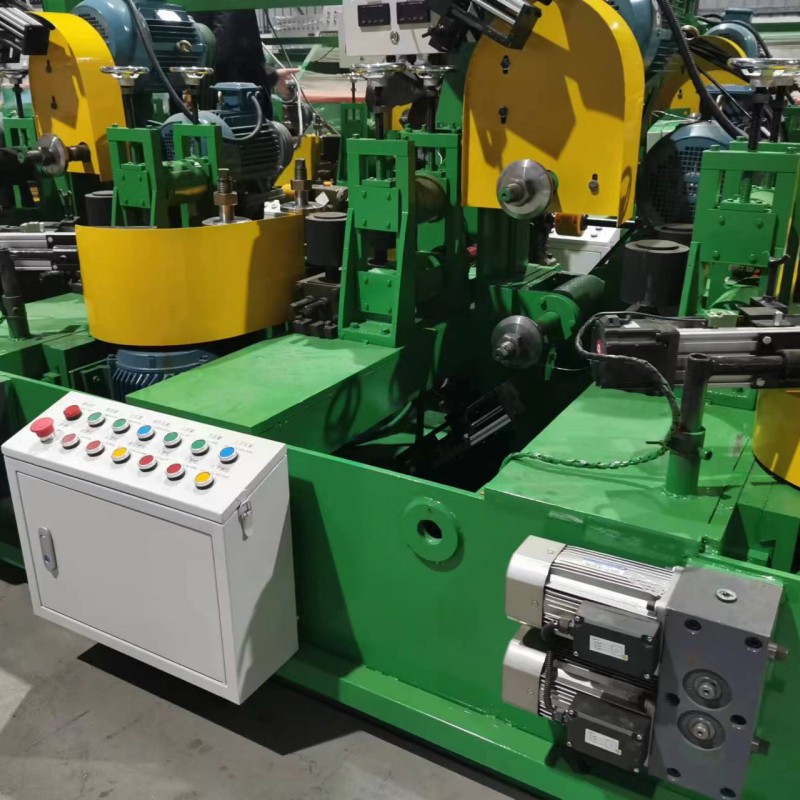
The frame and enclosure. A welded channel-steel frame with a heavy steel table top — commonly 10 mm plate on the smaller machines and up to 20–25 mm on the large pipe machines — so that the machine does not vibrate while the heads are cutting. Dust and motor covers are part of the frame, not an afterthought.
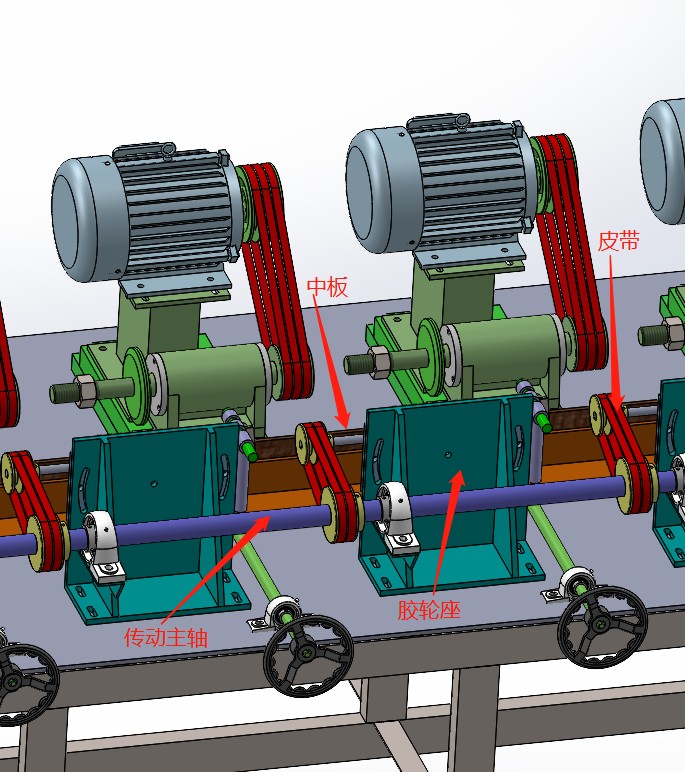
The grinding heads. Each head is a motor-driven spindle carrying the wheel or belt. Spindles are usually made from 40Cr steel, through-hardened, high-frequency treated and ground so they hold accuracy and last. Head motors run from 3–4 kW on light machines up to 11 kW per head on large pipe machines.
The conveying and rotation system. Rubber rollers grip and drive the tube along the bed while rotating it, so that a round tube presents its whole circumference to each wheel. These rollers are a wear part: on the big machines they are 113–180 mm rubber wheels rated to 120 °C, because an overheated roller will pick up and mark the tube surface.
The loading and unloading racks. V-type or automatic racks carry long tube into and out of the machine. On heavy six-metre tube, an automatic loading rack and an anti-damage unloading rack are close to essential, because manual handling of a 33 kg bar is slow and damages the finish you just produced.
The wax and dust systems. An automatic waxing unit sprays or throws compound onto the polishing heads so the operator does not have to wax by hand; a dust-collection or water-treatment system captures the grinding residue. Both are described in sections 8 and 9.
5. How many heads do you need?
This is the question that decides the price of the machine, and the answer comes straight from the finishing sequence. Every head carries one abrasive, and the surface steps from coarse to fine as the tube travels from head to head. The rougher the incoming tube and the finer the required finish, the more heads you need.
Light sanding or a single-stage finish — 1–2 heads
A single-head or two-head machine draws a hairline or satin finish, removes light marks or prepares a surface for a later brightening pass. Two heads often run one abrasive and one buffing wheel.
A bright finish on smooth stock — 3–4 heads
Cold-rolled tube often reaches a good bright finish with three or four heads: one or two grit stages, then a hemp and a cloth wheel. Conveyor-type machines are commonly built with three heads as the standard starting point.
A mirror finish on raw tube — 6 heads
Six heads is the classic configuration for stainless tube. A typical small-tube machine runs six heads at up to 2,300 rpm with a 36 mm spindle and about 29.7 kW total power, over a working range of roughly Φ16–Φ113 mm.
A true mirror on hot-rolled tube — 10 or more heads
Hot-rolled tube arrives rough and inconsistent, so it needs a long grit ladder. A real ten-head configuration we built for six-metre Φ50–Φ114 mm tube runs flap wheels from 120# through 180#, 240#, 320#, 400# and 600# for roughing, then pure-oil hemp wheels with pipe polishing wax and cloth hemp wheels for the mirror stage.
Two machines can beat one long machine
Where a tube is very rough, it is often cheaper to rough and polish on two machines than to build one with enough heads to do both. A common layout is one roughing machine and one polishing machine working in series. If output is low, a single machine can do both by changing the wheels between runs — but the process must be re-set each time, so it only pays below a certain monthly volume.
6. Round tube: choosing by diameter
Round-tube machines are best understood as a series of diameter classes. As the tube grows, the machine's spindle, motors, rollers and frame all scale up with it, and so does the price. These are configurations we actually build:
Tube diameter
Heads
Working length
Notes
Φ8–70 mm
1
up to 8 m
Entry-level single-head machine, dry grinding
Φ10–50 mm
2 (hemp + cloth)
100–6,000 mm
Two-head machine, 4 kW × 2, about 8.75 kW total, 600 kg
Φ16–Φ50 mm
6
400–6,000 mm
Small-tube mirror machine, 5.5 kW × 5 on the heads, 29.7 kW total, 113 mm rollers
Φ51–Φ113 mm
6
400–6,000 mm
Same frame with 150 mm rollers and a spring-cushioned head for ovality
Large pipe machine, 11 kW heads, 52 mm spindle, about 93.5 kW total
Φ50–Φ114 mm
10
6 m tube
Ten-head electric-adjust line for hot-rolled tube, about 78.7 kW total
Indicative configurations from machines we have built and quoted. The final specification is set from your tube, material and finish.
Two details separate a machine that works from one that fights the operator. The first is the rubber roller: as tube weight rises, undersized rollers flatten and mark the surface, which is why large machines step up to 150–180 mm heat-resistant rollers. The second is the spring cushioning device fitted to the large-pipe heads — drawn and welded pipe is never perfectly round, so a rigid head would ride the high spots and cut only the low ones, leaving an uneven finish. A cushioned head follows the tube's wobble and keeps the contact even.
7. Square tube: four faces in one pass
Square tube cannot be rotated against a wheel, so it is polished a different way: the machine runs one set of four heads per processing stage, positioned top, bottom, left and right, and treats all four faces of the section at the same time as the tube passes through. Add a second processing stage and you add another set of four heads, so an eight-head machine completes a coarse and a fine stage in a single pass — a finish that would be slow and inconsistent by hand.
Two options are worth calling out. The first is head oscillation — letting the wheel sweep left and right as it works. A fixed wheel leaves a straight, lined pattern; an oscillating wheel leaves a softer, blotch-free finish, and it is the option most customers add. The second is the dust cover: because square-tube grinding throws a large volume of fine dust, the enclosure and exhaust port that duct the dust to a collector are as much a part of the machine as the heads. A square-tube machine can also be specified as a wet machine (section 9) where the material calls for it.
8. Abrasive belt vs. buffing wheel heads
Within any of the families, the head itself comes in two kinds, and the choice shapes the whole process.
Buffing-wheel heads carry sisal, hemp, cloth or nylon wheels and remove less material per pass but produce the bright, reflective finish that stainless tube is bought for. They are the standard choice for the finishing end of a line, and they pair with polishing wax to cut and colour in the same pass — the same wheel-and-compound logic that governs choosing the right polishing wheel and choosing a polishing compound.
Abrasive-belt heads carry a running belt and remove material far faster, which is why they do the grinding and the pre-polish. Belt machines are commonly sold as single-, double- or four-belt units, and the belt head can be swapped for a buffing head on the same frame. A conveyor-type pipe machine, for example, is often quoted with three buffing heads and then allows each of those heads to be converted to an abrasive-belt head — with a wider belt available as a further option. Belt size varies with the machine: a light tube machine might run a 1,820 × 120 mm belt, while a small curved-tube sander uses a narrow 460 × 15 mm belt to follow a bend.
Grinding and polishing are different jobs
An abrasive belt grinds; a buffing wheel polishes. Putting them on the same machine in the right order is what turns a rough tube into a mirror — but the belt is there to remove material, not to make it shine, and the wheel is there to make it shine, not to remove material. Confusing the two is the fastest way to burn a tube surface or to polish forever without removing a single scratch. Our note on polishing vs. grinding explains the dividing line.
9. Wet vs. dry grinding — and dust safety
Tube machines run either dry or wet, and the choice is decided by the material, the finish and how much airborne dust the shop can tolerate.
Dry grinding is the default. It is simpler, cheaper and perfectly adequate for the great majority of stainless and aluminum tube. Because dry grinding and polishing generate fine metal and abrasive dust, a dry machine is normally paired with a dust-collection system, and where the dust is combustible the collector itself must be explosion-proof. A typical belt machine set-up pairs a tube machine with a 3 kW dust-treatment unit pulling 6,132–7,230 m³/h through a three-layer stainless water curtain and a stainless filter, with all electrical components in explosion-proof configuration. The wider subject of combustible dust is covered in our guide to preventing combustible dust explosions, and the hardware lives in the explosion-proof dust collector category.
Wet grinding adds a stainless water pan and a spray-and-recirculation system to the abrasive-belt head, so the belt runs cool and most of the residue is caught in the water rather than thrown into the air. Wet machines suit heat-sensitive work, very fine finishing, and any process where airborne dust has to be suppressed at the source. Our wet belt sander range covers single- and dual-station wet machines — for example a single-belt pipe machine for Φ5–50 mm tube with a 100 mm belt, or a two-head machine combining one belt head and one buffing head — and the water sanding belt machine and dual-station wet abrasive belt grinder pages describe the individual models.
Consideration
Dry grinding
Wet grinding
Simplicity & cost
Lower cost, less plumbing, easier maintenance
Higher cost, needs a water system and regular water changes
Heat on the workpiece
Belt and tube heat up faster
Belt runs cool; far less risk of burning thin or heat-sensitive tube
Dust
Needs a dust collector; combustible dust requires explosion-proof equipment
Most residue captured in the water tank; much less airborne dust
Best for
Most stainless and aluminum tube, high output
Heat-sensitive stock, fine finishing, dust-sensitive shops
10. The consumables that decide the finish
The machine sets the process; the consumables decide the result. A tube polishing machine is only as good as the belt, wheel and compound running on it, so a realistic budget includes a consumables plan, not just the machine.
Consumable
Stage
Typical specification
Flap / leaf wheel
Roughing & grit ladder
300 × 50 mm, 36 mm bore, grits 120# / 180# / 240# / 320# / 400# / 600#
350 × 12 mm, 36 mm bore, run with pipe polishing wax
Cloth hemp wheel
Final colour
350 × 12 mm, 36 mm bore
Nylon wheel
Light deburr / satin
Matched to the head and section
Pipe polishing wax
Cut & colour
Approx. 975–1,000 g per bar, 20 bars per box
Sizes from real tube-polishing machine configurations and consumable quotations.
Because the wheels and the wax are consumed continuously, they are the natural place to build a recurring supply relationship — and, if you are a distributor, to put your own brand (section 12).
11. A real setup: 60 mm hot-rolled stainless tube
An example makes the whole process concrete. A customer needed six-metre, 60 mm diameter, 3 mm wall, 316/304 hot-rolled steel tube brought to a bright finish, with each bar weighing about 33 kg. Hot-rolled tube has an inconsistent surface, so the process was built in two stages on ten-head machines.
Roughing stage. A ten-head machine runs flap wheels in an ascending grit ladder: 120# on two heads (with the note that 100# or even 80# can be used if the incoming surface is very rough), then 180# on two heads, 240# on two heads, 320# on two heads, 400# on one head and 600# on one head. The goal of the roughing stage is simply to bring the whole surface to a uniform 600# scratch pattern.
Polishing stage. A second ten-head machine takes over with pure-oil hemp wheels on four heads feeding pipe polishing wax, pure-oil hemp wheels on two heads without wax, and cloth hemp wheels on the last four heads for final colour and gloss. Four of the heads are fitted with an automatic waxing unit, because the first heads in the polishing stage need wax to work.
Two practical points came out of that job and apply to almost every tube line. First, the machine is fitted with an automatic loading rack and an anti-damage unloading rack — with tube this heavy and this long, manual handling is slow and damages the finish you have just produced. Second, the whole plan is built around the fact that the tube is hot-rolled: if the customer had supplied cold-rolled tube, the surface would have started much smoother and several roughing heads could have been dropped, which would have changed the machine specification and the price.
Tell us the raw stock, not just the finished part
The single biggest cost driver on a tube machine is the starting surface. Hot-rolled, cold-rolled, drawn, welded and extruded tube of the same diameter need different numbers of heads. Sending a sample of the raw tube — and a note of the finish you need — lets us specify the shortest, cheapest line that will actually get there.
12. Customization, OEM & consumables
Custom Built · OEM / ODM
Your tube, your process — and your brand on the consumables
There is no such thing as a stock tube polishing machine, because no two tubes are the same. Customization is not an option here; it is how the machine is built. We configure the machine around your part, and we build the consumables that keep it running — under your own brand if you want it.
Head count & head type — from a single head to fourteen, in buffing-wheel, abrasive-belt or mixed configuration, with the grit ladder set to your starting and finishing surface
Tube range & working length — diameter or section range, wall thickness and maximum working length built to your product
Feeding & handling — manual, V-type, automatic loading and anti-damage unloading racks sized to the tube's weight and length
Wax & dust systems — automatic spray or solid waxing, dry dust collection with explosion-proof equipment, or a wet water-treatment system
OEM / ODM consumables — custom logo, weight, colour and carton on polishing wax, cloth and sisal wheels, abrasive belts and discs and polishing brush heads
1–14Heads, buffing wheel or abrasive belt
Φ8–530 mmRound tube; square and profiled sections too
Full lineMachine, consumables and OEM branding
The reason we push the consumables side so hard is simple: a tube polishing machine is bought once every several years, but the flap wheels, abrasive belts, hemp and cloth wheels and pipe polishing wax are consumed continuously. Our OEM and ODM support covers that recurring, own-brand supply across polishing wax, buffing and sisal wheels, abrasive belts and discs and polishing brush heads — the same private-label programme described in our polishing compound guide. For a distributor, it turns a one-off machine sale into a steady, branded consumables business.
13. Frequently asked questions
What is a tube polishing machine?
A tube polishing machine is an automatic finishing machine that feeds a round, square or profiled tube lengthwise past a series of motor-driven grinding and polishing heads to sand, draw or mirror-polish its surface. The tube is carried by a roller conveyor rather than held by hand, and each head carries a different wheel or abrasive belt so that roughing, medium and fine stages are completed in one continuous pass. Machines are built around three variables: the tube diameter or section, the tube length, and the number of heads needed to reach the required finish.
How many polishing heads do I need on a tube polishing machine?
It depends on the starting surface and the finish you need. A light sanding or a single-stage bright finish can be done with one or two heads. A true mirror finish on raw or hot-rolled tube usually needs six or more heads, because each head carries one grit so the surface steps from coarse to fine in sequence. Where a hot-rolled tube has deep pits, our engineers typically specify a roughing machine followed by a separate polishing machine, or a ten-head machine that runs a 120# to 600# sequence before the cloth and hemp wheels take over. Cold-rolled tube starts smoother and often needs fewer heads.
Can a tube polishing machine polish square tube on all four sides at once?
Yes. A square tube grinding machine uses one set of four heads per processing stage, positioned top, bottom, left and right, so all four faces of the square section are treated simultaneously as the tube passes through. Adding a second processing stage adds another set of four heads, so an eight-head machine finishes both a coarse and a fine stage in a single pass. Our conveyor-type square tube grinding machine, the YL-APM-077-4, takes square tube of 20-100 mm by 20-100 mm and 600-6,000 mm long on this principle.
What is the difference between wet and dry tube polishing?
Dry tube polishing uses abrasive belts and wheels without coolant and is the standard method for most stainless steel and aluminum tube. Wet tube polishing adds a water-spray and recirculation system to the abrasive belt head so the belt runs cool, which suits heat-sensitive work, fine finishing and any process where airborne metal and abrasive dust must be suppressed at the source. Because dry grinding and polishing produce combustible metal dust, a dry tube machine is normally paired with an explosion-proof dust treatment unit, whereas a wet machine captures most of the residue in its water tank.
What consumables does a tube polishing machine use?
The main consumables are flap (leaf) wheels, abrasive belts, nylon wheels, sisal or hemp wheels, cloth wheels and polishing wax. A typical multi-head sequence uses flap wheels in ascending grits such as 120#, 180#, 240#, 320#, 400# and 600# for the roughing stage, then pure-oil hemp wheels with pipe polishing wax and cloth hemp wheels for the brightening stage. Abrasive belts come in standard sizes such as 1,820 x 120 mm and 50 x 2,100 mm depending on the machine.
Can tube polishing machines be customized, and do you offer OEM?
Yes. There is no single standard tube polishing machine, because every tube differs in diameter, section, length and required finish, so customization is the norm rather than the exception. We configure the number of heads, the wheel or belt type, the working length, the diameter range, the loading and unloading racks, the automatic waxing system and the dust or water treatment to the customer's tube and process. On the consumable side we also offer OEM and ODM production, covering polishing wax, cloth and sisal wheels, abrasive belts and discs and polishing brush heads, with custom logo, weight, colour and carton.
Send us your tube — we will spec the machine
Tell us the tube: round, square or profiled, its diameter or section, its length and material, whether it arrives hot-rolled or cold-rolled, and the finish you need. We will recommend the right number of heads, the wheel or belt sequence and the feeding system — and quote it. If you distribute, ask about OEM consumables under your own brand.
Yi-Liang Polishing · 20+ years in polishing equipment & consumables · Exporting to 60+ countries · Custom-built machines & OEM consumables
YL
Yiliang Polishing Engineering Team Written by the engineers at Guangzhou Qianma Technology Co., Ltd. / Yiliang Polishing — specialists in polishing machines, polishing lines and consumables, with more than 20 years of industry experience and a decade of export experience across Asia, Europe, Africa and the Americas. www.yl-polishing.com


 English