Polishing Compound Explained: How to Choose the Right Buffing Wax for Stainless Steel, Aluminum & Copper
Polishing Compound Explained: How to Choose the Right Buffing Wax for Stainless Steel, Aluminum & Copper
October 06, 2026
Luo Haibo serves as core technical director and primary patent inventor at Qianma Technology, the original manufacturer of automatic polishing machines. He possesses decades‑long hands‑on expertise in metal‑surface polishing and consumable matching, leading R&D for polishing‑machine mechanical structures and process optimization. As the official export brand, Yiliang Polishing (operated by Guangzhou Yiliang Trading Co., Ltd.) delivers global market services and full‑range polishing consumables. Jointly we provide factory‑direct one‑stop metal‑surface finishing solutions for worldwide manufacturing clients.
Luo Haibo – CEO, Yiliang Polishing
A polishing compound — also called buffing wax — decides whether a metal part comes out mirror-bright or scratched. Black, white, green or blue? The colour alone tells you almost nothing: what matters is cutting force, gloss and grease. This guide shows how to match the right buffing wax to your metal, your wheel and your finish.
By Yiliang Polishing Engineering Team · Updated October 6, 2026 · 11 min read
Quick Answer
A polishing compound (also called buffing compound or polishing wax) is an abrasive carried in a wax or grease binder, applied to a spinning wheel to cut and brighten a metal surface. Choose it by three variables: cutting force (how fast it removes metal), gloss (how bright it finishes) and grease content (how much residue it leaves). Match the compound to the metal and the wheel, work through a rough → medium → fine sequence, and you get a repeatable mirror finish instead of guesswork.
Polishing compound is the least glamorous item in a finishing shop and one of the most consequential. Get it right and a mediocre wheel produces a bright, uniform surface; get it wrong and the best machine in the building still leaves swirl marks, smeared aluminium or wax trapped in a stainless weld. This guide explains what is actually inside the bar, how to read a compound's behaviour, and how to choose the correct grade for the metal in front of you.
1. What polishing compound actually is
Definition
A polishing compound is a blend of an abrasive (alumina, silicon carbide, chalk or similar), a binder or grease (tallow, stearic acid or a synthetic wax) and a carrier that gives the bar its colour and behaviour. The abrasive does the cutting, the binder holds it together and lubricates the surface, and the colour usually signals the grade.
The key idea is that a polishing compound is a system, not an ingredient. The abrasive decides how much material is removed per pass; the binder decides how smoothly the abrasive glides and how much residue is left behind. Two bars that look identical can behave completely differently because of how those two parts are balanced.
Ignore the marketing names. Three measurable properties describe almost any compound, and once you can trade them off against each other, selection becomes straightforward.
Cutting force — how aggressively the abrasive removes material. High-cut compounds are coarse and fast; they flatten scratches and levelling marks quickly but leave a duller finish. Low-cut compounds refine and brighten without removing much metal.
Gloss (brightness / luminosity) — how reflective the resulting surface is. Fine abrasives in a smooth binder produce the deep, mirror-like finish that stainless steel, brass and copper are bought for.
Grease / binder content — how much lubricating wax the bar carries. More grease means a cooler, smoother cut and heavier residue; less grease (a "dry" compound) runs cleaner and leaves less wax trapped in the surface.
The trade-off nobody escapes
Cut and gloss pull in opposite directions: the more a compound cuts, the less it can polish. That is why professionals never look for one "perfect" wax — they use a sequence of them. A high-cut bar does the levelling, a medium bar removes its scratches, and a fine bar delivers the mirror. Trying to reach a mirror finish with a high-cut compound is the single most common cause of a permanently smeared surface.
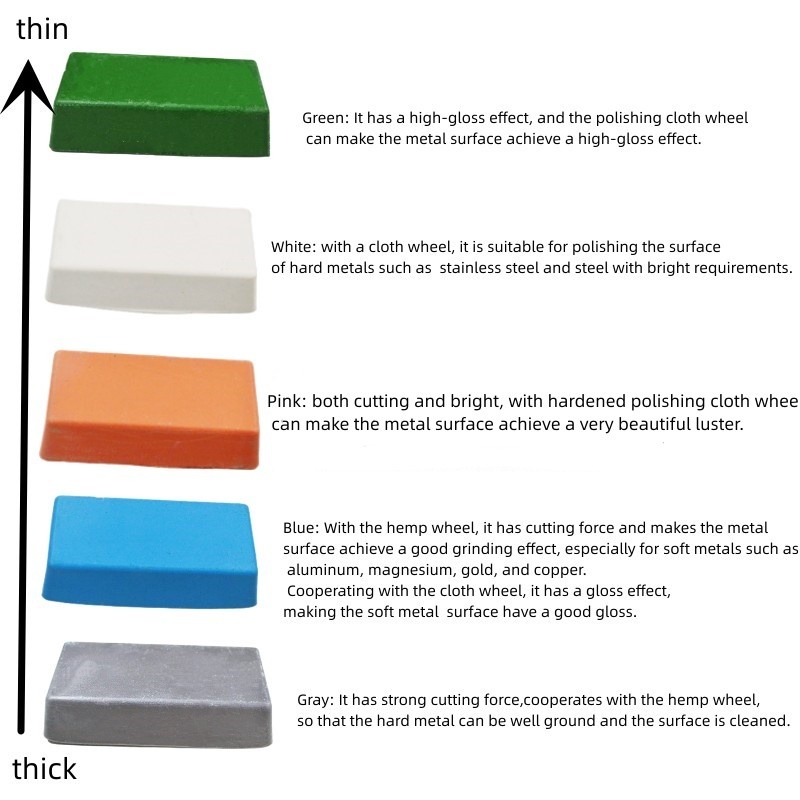
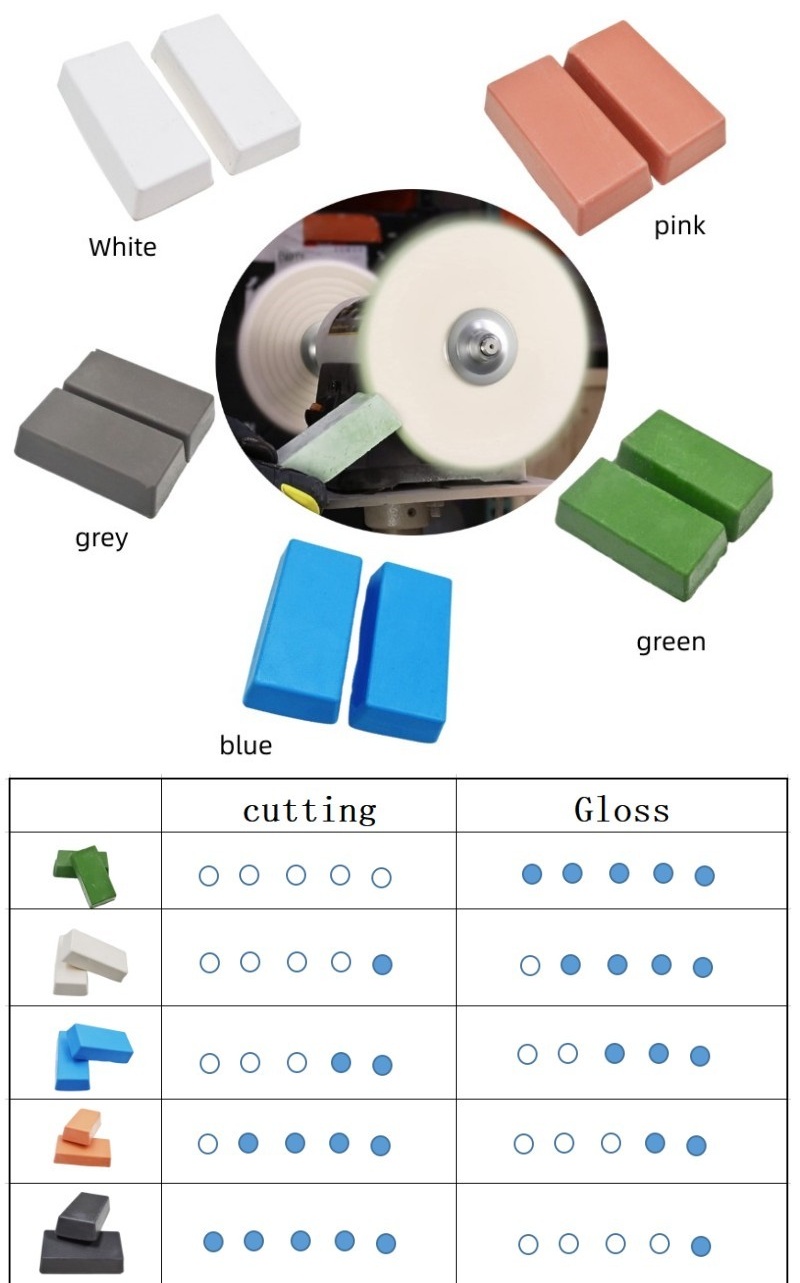
3. Colour-to-purpose cheat sheet
Colour is a convention, not a rule — always confirm the specification — but in most polishing shops the colour of the bar points to the job. Here is how the common colours map to real work:
Colour
Cutting force
Gloss
Typical use
Black
Medium – strong
High
Iron and steel; run with a flax / hemp wheel for fast bright cutting
White
Light
High
Final bright finishing of most metals; cloth wheel, low aggression
Green
Light – medium
High, low residue
Stainless steel and kitchenware; drier grades leave less wax in the surface
Blue
Strong
High
Rough and medium grinding of stainless parts; fine, even lines
Black-green
Regular
Super mirror
Final mirror polishing where maximum luminosity is required
Yellow / sand
Assist / strong
Brightening
Support compound used with abrasive belts, sandpaper or steel sand
Grey / white slurry
Rough → fine
Mirror
Barrel compound for automatic lines (27D, 297, 3N, 4K)
Colour conventions vary between manufacturers — always confirm cut and gloss, not just the colour.
4. Bar wax vs. barrel slurry: two formats, two jobs
Polishing compound is supplied in two physical forms, and the choice between them is decided by how you polish, not by the metal.
Solid bars — typically 1 kg pieces packed 20 to a carton — are pressed against a spinning wheel by hand. They suit manual benches, job shops and any operation where an operator changes wheels and compounds piece by piece. A bar gives the operator instant, tactile control over how much compound goes onto the wheel.
Barrel slurry — usually 50 kg drums of a paste-like compound — is fed onto the wheel automatically, either pumped or thrown from a slinger. It is the format of choice for automatic polishing lines, where a continuous and repeatable supply of compound is essential to keep every part identical. If you are running conveyor-fed or rotary-table polishing, slurry is almost always the right answer.
5. Matching the compound to the metal
The metal dictates the cutting force you can safely use and the residue you can tolerate. These are the starting points our engineers use for each family.
Stainless steel. The workhorse material for polishing, and the one that rewards a staged approach. Begin with a stronger-cut bar such as a blue wax or a grey roughing compound on a hemp or sisal wheel to level the surface, follow with a green or white compound on a cloth wheel for medium gloss, and finish with a fine mirror compound such as 3N or 4K. For stainless kitchenware, choose a light-coloured, low-residue green wax — it leaves less compound trapped around handles and lid seams, which saves a cleaning step downstream.
Aluminum. Softer and "gummier" than steel, aluminium smears instead of cutting cleanly if the compound is too aggressive. Use a light-cut compound with good lubricity on a soft cloth or loose-fold wheel at reduced speed, and avoid heavy, greasy bars that load up the wheel. Over-cutting aluminium is far more damaging than over-cutting steel.
Copper, brass and bronze. These softer non-ferrous metals respond beautifully to light-cut, high-gloss compounds such as white or fine green waxes. Because they are relatively soft, the primary goal is the mirror, not the cut — go gentle and step up the gloss.
Iron and carbon steel. Harder and more forgiving, iron and steel tolerate medium-to-strong cutting compounds like the black waxes, which cut quickly and bring up a high brightness. These are usually run with a flax or hemp wheel for the cutting stage.
Plastic, acrylic and painted surfaces. Non-metallic substrates need a purpose-made compound — a dedicated plastic wax on a soft polishing wheel — to avoid heat build-up and surface burn. The same logic applies to painted panels; see our note on the paint surface polisher category for the material-specific approach.
6. Matching the compound to the wheel
Compound and wheel are a matched pair; changing one without the other is the fastest way to spoil a finish. As a rule of thumb, match a strong-cut compound to a stiff, open wheel and a fine compound to a soft, dense one:
Wheel
Pairs best with
Stage
Hemp / sisal (flax) wheel
Black, blue or roughing compound
Rough cutting and levelling
Cloth / cotton wheel
Green, white, fine compounds
Medium and final polishing
Soft / loose-fold wheel
White, mirror-grade compound
Final colour and high gloss
Belt / abrasive belt
Sand, yellow or assist compound
Grinding and pre-polish
Because a matched wheel-and-compound pairing delivers so much of the final result, our range covers both sides of the equation — the air cloth polishing wheel for the wheel stage, and the compounds below for the abrasive. Pairing them from a single supplier is the simplest way to keep results consistent from batch to batch.
7. The three-step polishing sequence
Every mirror finish in a professional shop is built in stages, with each stage removing the scratches left by the one before it. Skipping a stage does not save time — it pushes the defect further down the line, where it costs far more to fix.
Rough — levelling
Remove surface defects, weld discolouration and coarse scratch marks with a high-cut compound such as grey 27D on a hemp wheel. The finish looks dull; that is expected. The goal here is flat, defect-free metal.
Medium — refining
Erase the rough-stage scratches with a medium compound such as 297 or a blue wax on a cloth wheel. The surface starts to brighten and the fine, even lines of a well-prepared panel appear.
Fine — mirror
Deliver the final gloss with a fine compound such as 3N (mirror) or 4K (high-requirement mirror) on a soft cloth wheel. This stage adds no material removal to speak of; it only refines the surface to full reflectance.
One rule that saves hours
Never move to the next stage until the previous stage's scratches are gone. A 30-second check under a bright, angled light will tell you whether the surface is ready — far cheaper than discovering a hidden scratch after you have polished to a mirror.
8. The YOL polishing compound range
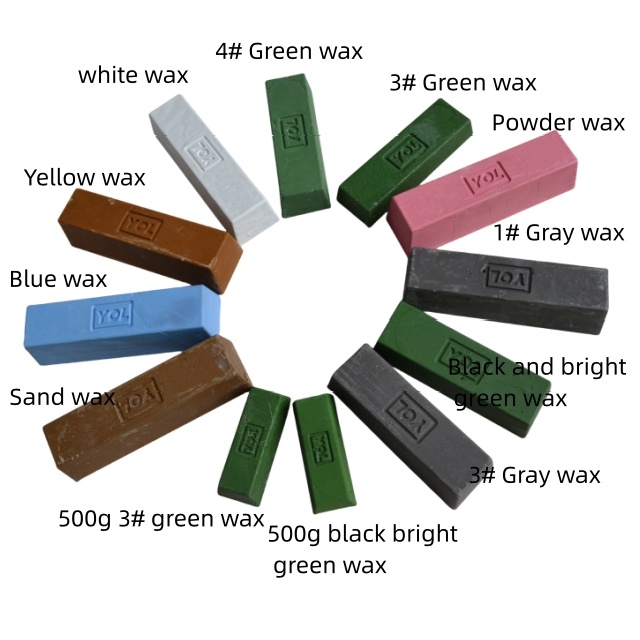
The YOL series covers the full cut-to-mirror sequence in both bar and barrel formats. The table below lists the standard range; treat the cutting force and gloss columns as the decision variables and the model number as the shopping shortcut.
Solid bar waxes — 1 kg pieces, packed 20 per carton:
Model
Compound
Cut
Gloss
Best for
YOL1#
Black polished wax
Medium
High
Iron and steel; run with a flax wheel for a fine, high-brightness grain
YOL3#
Black polished wax
Strong
General
Grinding on metal surfaces where speed matters more than final gloss
YOL0#
Powder polished wax
Balanced
Balanced
Medium-fine polishing of metal parts; hemp and cloth wheels
YOL2#
Powder polished wax
High
General
Medium-fine grinding of metal surfaces; hemp and cloth wheels
YOL
White polished wax
Light
Good
Fine polishing of almost any metal; cloth wheel
YOL
Black bright green wax
Regular
Super mirror
Highest-luminosity mirror polishing of metal surfaces
YOLA3
Green wax
Light
Good, dry
Bright finishes with little residual wax left on the workpiece
YOLA4
Green wax
Stronger
Medium
Fine polishing of larger stainless steel kitchenware; cloth wheel
YOL2#
Blue wax
Strong
High
Rough and medium grinding of stainless steel parts; fine, even lines
YOL
Sand wax
Strong
Good
Used with steel sand, cloth wheel and belts; heavy grease, strong cut
YOL
Yellow wax
Assist
Brightening
Assists grinding and brightening with belts, wheels and sandpaper
YOL
70D plastic wax
Light
High gloss
Acrylic and plastic surfaces with a polishing wheel
Barrel slurry compound — 50 kg drums, for automatic lines:
Model
Compound
Stage
Best for
YOL27D
Rough polishing slurry (grey)
Rough
Hemp polishing of stainless steel and similar metals; hemp wheels
YOL297
Medium throw slurry (white)
Medium
Base polishing with cloth wheels
YOL3N
Fine polishing 3N
Fine
Final fine polishing to a mirror-high finish; cloth wheel
YOL4K
Fine polishing 4K
Fine
High-requirement mirror finishes; fine polishing cloth wheel
Alongside the standard series we supply a fine crystal polishing wax in cylinder form, developed for high-gloss, low-residue finishing of watches, jewellery, small metal accessories and furniture hardware. It brings up a mirror finish on small precious-metal parts where a softer, finer compound is needed — and, like the rest of the range, it is available with OEM branding.
Not sure which grade matches your workpiece? Send us a sample and the finish you need, and our engineers will recommend the correct cut-and-gloss combination from the range — or specify a custom blend for your application.
9. Private label & OEM — your brand on the bar
Private Label · OEM · ODM
Put your own logo on the polishing wax your customers re-order
Polishing compound is a consumable — the same customers buy it again and again, month after month. That makes it one of the best candidates in an entire polishing catalogue for a private-label programme: every re-order becomes a re-order of your brand, not a competitor's generic bar.
Custom logo — your name and mark moulded into the bar, replacing the standard YOL stamp
Custom weight — change from the standard 1 kg bar to the piece weight your market expects
Custom colour & carton — packaging and carton branding to match your range
Formulation on request — tailored cut and gloss for a specific metal or a specific competitor specification
500 pcsMinimum order per model — one automatic production run
1 kgStandard bar size (custom weights available)
CustomLogo, weight, colour and carton
How it works in practice: our standard range is produced on automatic equipment in batches of 500 pieces per model, which keeps unit cost low and quality consistent. A custom bar requires a dedicated mould — a one-time tooling cost — after which production runs exactly like the standard range. Distributors, polishing-supply brands and distributors' own-label lines use this route to build recurring consumable revenue under their own name. The same OEM and ODM support extends across our wider consumables range — cloth and sisal wheels, wing wheels, abrasive belts and discs, and polishing brush heads — so a distributor can build a complete own-brand finishing programme from a single supplier.
Why branded consumables matter more than branded machines
A polishing machine is bought once every several years; consumables are bought continuously. An own-brand compound locks in the repeat purchase and quietly increases the lifetime value of every customer you sell a machine to. For many distributors it becomes the most profitable line in the catalogue.
10. Frequently asked questions
What is polishing compound made of?
Polishing or buffing compound is a blend of three ingredients: an abrasive (such as alumina, silicon carbide or chalk) that does the cutting, a binder or grease (tallow, stearic acid or a synthetic wax) that holds the abrasive and lubricates the surface, and a carrier that gives the bar its colour and its specific behaviour. The grade and amount of abrasive set the cutting force; the binder controls gloss and how much residue is left behind.
What is the difference between polishing compound and buffing compound?
The two terms are widely used interchangeably and often describe the same bar. In strict polishing-shop language, buffing compound is the more general term for any wheel-applied compound, while polishing compound is sometimes reserved for the finer grades used in the final, highest-gloss stage. What matters in practice is the cut-and-colour grade, not the name.
Which polishing compound is best for stainless steel?
Stainless steel is usually finished in stages. Start with a stronger-cutting compound such as a blue wax or a grey roughing bar on a hemp or sisal wheel, move to a green or white compound on a cloth wheel for medium gloss, then finish with a fine mirror compound such as 3N or 4K on a soft cloth wheel. Light-coloured, low-residue green waxes are popular for stainless kitchenware because they leave little wax trapped in the surface.
Can I use polishing compound on aluminum?
Yes, but aluminum is softer and gummier than steel, so it needs a compound with less cutting force and more lubricity to avoid smearing. Use a light-cut polishing compound on a soft cloth or loose-fold wheel at low speed, and avoid heavy greasy bars that load the wheel. For manual aluminum work, a white or fine green compound is usually the safest starting point.
What is the difference between a bar of polishing wax and a barrel of polishing slurry?
Solid bars (typically 1 kg, packed 20 per carton) are pressed wax pieces applied directly to a spinning wheel, which suits manual benches and job shops. Barrel slurry (usually 50 kg drums) is a paste-like compound pumped or thrown onto the wheel, designed for automatic polishing lines that need a continuous, repeatable feed of compound.
Can I get polishing wax with my own brand and logo?
Yes. Our standard bar is a 1 kg piece moulded with the YOL logo, but we offer private-label and OEM production: you can change the weight and add your own logo, and tailor the colour and carton. A custom mould is a one-off tooling cost, and the minimum order quantity is 500 pieces per model — one automatic production run. Private-label compound is an easy way for distributors and polishing-supply brands to build recurring, branded consumable revenue.
Get the right compound — or your own brand of it
Tell us the metal you polish, your wheel type and the finish you need. We will recommend the correct grade from the YOL range, quote it, and — if you want a private-label line — walk you through logo, weight and mould options.
Yi-Liang Polishing · 20+ years in polishing equipment & consumables · Exporting to 60+ countries · Private-label & OEM available
YL
Yiliang Polishing Engineering Team Written by the engineers at Guangzhou Qianma Technology Co., Ltd. / Yiliang Polishing — specialists in polishing machines, polishing lines and consumables, with more than 20 years of industry experience and a decade of export experience across Asia, Europe, Africa and the Americas.


 English