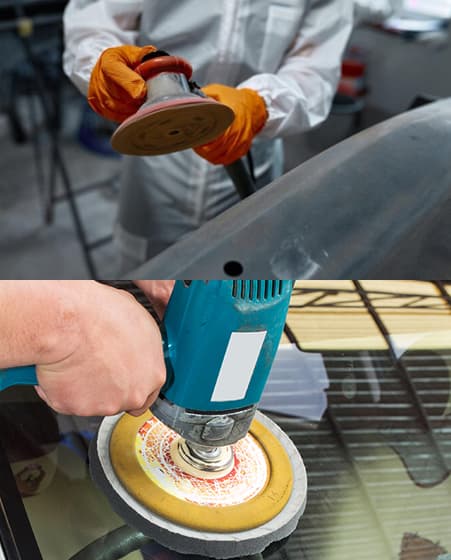
Paint Surface Polishing Machine: A Panel Finishing Guide
Paint Surface Polishing Machine: A Panel Finishing Guide
November 11, 2026
Luo Haibo serves as core technical director and primary patent inventor at Qianma Technology, the original manufacturer of automatic polishing machines. He possesses decades‑long hands‑on expertise in metal‑surface polishing and consumable matching, leading R&D for polishing‑machine mechanical structures and process optimization. As the official export brand, Yiliang Polishing (operated by Guangzhou Yiliang Trading Co., Ltd.) delivers global market services and full‑range polishing consumables. Jointly we provide factory‑direct one‑stop metal‑surface finishing solutions for worldwide manufacturing clients.
Luo Haibo – CEO, Yiliang Polishing
Paint polishing is not sanding wood. You are levelling a 60–120 µm film, so the grit schedule — not motor power — decides gloss or sand-through.
By Yiliang Polishing Engineering Team · Updated November 9, 2026 · 13 min read
Quick Answer
Paint surface polishing is the step after the final coat has cured: you level the film with a fine abrasive, then restore gloss with a cloth wheel or wool pad and a paint polishing compound. Three rules cover most of it. Sand each coat with the finest grit that still removes the previous coat's texture — typically P320 after primer, P400 after the base colour and P600–P800 after clear coat. Keep total stock removal low, because the whole film is only 60–120 µm thick — less than a human hair. And keep the panel cool: paint softens at roughly 60–80 °C, a temperature a dry buffing wheel can reach in seconds.
Furniture makers and panel processors eventually face the same wall: the lacquer line works, the parts come off the spray booth looking acceptable, and then the customer holds the panel under the light. Orange peel. Sanding scratches through the gloss. A hazy patch where someone leaned on the buffer too long. Paint finishing is where wood factories lose the most rework hours per square metre, and it is the stage where buying the right machine — and knowing which machine you actually need — pays for itself fastest.
This guide is written from real paint-line projects: a 2026 paint surface sanding and polishing line quoted for a Russian panel manufacturer, the widened gantry paint polishing machine built around the same requirement, flat paint polishing machines supplied to domestic furniture plants since 2017, and wide-belt wood sanders shipped to furniture buyers in 2023–2025. Where we quote a machine or a price, it comes from those files — flagged with the year it was quoted, because prices move.
1. You are polishing a film, not a board
Definition
Paint surface polishing (also called paint correction or clear-coat polishing) is the mechanical levelling and brightening of a cured paint film using a fine abrasive and a rotating or oscillating pad, removing micrometres of material — never enough to expose the colour layer or the substrate beneath it.
The mental model that separates professionals from strugglers is this: you are not sanding wood. You are sanding a coating. A finished furniture panel is a stack of layers, and every layer after the sealer exists to be flattened and brightened, not removed.
Layer
Typical dry film thickness
Its job
What goes wrong here
Sealer / wash coat
10–30 µm
Seals the substrate and stops the next coat soaking in unevenly
Skipped or too thin — the primer soaks in and adhesion drops
Primer / filler
30–80 µm
Fills wood grain or MDF fibre; the layer you sand the hardest
Sanded too aggressively after curing — level drops below minimum
Base colour
20–40 µm
The colour you actually see
Sand-through here shows substrate colour — instantly visible
Clear / topcoat
30–60 µm
Gloss and protection; the layer you polish
Burned by a dry buffing pad; hazy from overheating
Dry film thicknesses are typical ranges for solvent- and water-based furniture coatings; confirm against your own coating supplier's data sheet.
Add the layers up and a typical furniture finish is 60–120 µm thick in total — about the diameter of a human hair. That number should recalibrate how you think about every machine setting in this article. A belt that removes 0.1 mm in one pass removes the entire finish in one pass.
The one sentence to remember
On a metal polishing line, stock removal is measured in tenths of a millimetre. On a paint line, your entire working budget is one tenth of a millimetre — and you must still have finish left at the end of it. Every grit choice, every pressure setting and every second of dwell time spends from that budget.
2. Why panel flatness beats machine power
Here is the calculation that decides whether a paint polishing project succeeds, and almost nobody does it before buying a machine.
Suppose your panel varies 0.3 mm in flatness across its length — common for MDF coming straight off a press, or for solid-wood stiles and rails. Your film is 0.1 mm. If you press a rigid polishing head down until it touches the low spots, it has already cut 0.2 mm through the film at the high spots before the low spots ever see contact. No amount of motor power fixes this, because it is a geometry problem, not a power problem.
Real paint polishing machines solve it in three ways, and the best machines use all three:
A compliant head. A cloth wheel, a sponge-backed pad or a pneumatic pad unit conforms to the panel instead of planing it flat. On our two-station gantry paint polishing machine, the pad unit is pneumatic with seven independently rotating pads, so each pad floats over its own patch of surface.
Pressure control, not depth control. The machine should be set by contact pressure, never by "lower the head until it touches". The widened gantry machine we built senses pressure automatically and maintains it through the pass; the QM2A-120 flat machine holds head position with an oscillating wheel that rides the surface.
Vacuum hold-down on a true table. If the panel is not flat on the table, nothing downstream matters. Both machines above use vacuum suction tables; the gantry machine's linear-guide fence runs 3780 mm so a 3200 mm panel is referenced along its full length.
The practical rule we give customers: bring substrate flatness within about one third of your film thickness before the paint sanding stage. If you cannot, add a calibration or wide-belt sanding pass before coating — see the automatic belt sander and conveyor-type flat belt sander categories, and our guide to a custom wide-belt sanding machine for what that stage looks like on sheet material.
3. One coat, one grit: the grit-per-coat rule
The most expensive habit in paint finishing is skipping coats of grit — jumping from P180 straight to buffing, or sanding the final clear coat with P1000 "to be safe". Both cost more than they save.
The schedule below is the one we wrote for a Russian customer's panel line in 2026, where boards carry three coats of paint. It is a good template because it assigns every coat exactly one job and one abrasive:
Step
Stage
Consumable
Target
1
First coat (primer)
Sanding disc, coarse → fine, up to P320
Flatten the primer and remove cured texture
2
Second coat
Sanding disc / paper, up to P400
Level the second coat; leave a uniform anchor pattern
3
Third coat, sanding pass
Sanding disc / paper, up to P800
Knock down orange peel and texture before polishing
4
Third coat, first polish
Polishing cloth wheel + paint polishing compound
Remove P800 scratches; bring up initial gloss
5
Third coat, final polish
Wool polishing pad + paint polishing compound
Deep gloss; remove cloth-wheel micro-swirls
From a 2026 paint surface sanding/polishing machine quotation for a three-coat wooden panel line. Adjust the top grit to your coating system and the surface roughness you actually measure.
Three principles sit behind that table:
Finer is not better; sufficient is better. Each coat only needs sanding fine enough to remove the texture of the coat before it. Sanding the primer to P800 wastes discs, adds hours, and — because finer grits load and heat faster — often burns the primer you are trying to flatten.
Never jump more than about 1.6–1.8× between grits. P320 → P400 → P600 → P800 climbs evenly, so each grade only has to remove the scratches of the one before. Jumping P320 → P800 leaves the deep P320 scratches in place, and the compound will smear over them instead of removing them.
The finish is decided at the primer. This is worth repeating because it is the line we write into every paint-line quotation: the better the initial coarse sanding of the paint surface, the better the subsequent polishing results. A compound can hide a bad sanding job for an hour; it cannot hide it for a shipping container.
4. Three machines that are not the same thing
Searches for "furniture sanding machine" and "paint polishing machine" get mixed together, and buying the wrong category is the most common — and most expensive — mistake in this space. There are three distinct machine types, and they are not interchangeable:
Machine type
What it removes
Head
Where it belongs
Calibration / wide-belt sander
Millimetres — dimensions the board
Wide abrasive belt over contact roller
Before coating: flatten and thickness raw panels
Paint sanding machine
Tens of micrometres — levels each coat
Orbital / disc heads or fine belt, pressure-controlled
Between coats and after final coat
Paint polishing machine
Micrometres — levels and brightens the film
Cloth wheel and/or wool pad with compound
After final coat: the gloss step
A wide-belt sander set up for wood will go through a cured film in one pass — its pressure and stock-removal envelope are built for the substrate, not the coating. A polishing machine, conversely, cannot flatten a warped panel; it can only polish what is already flat. Buying decisions should start from the question "which of these three jobs am I actually buying?"
If your upstream problem is raw panel flatness, start with the belt sander and conveyor flat belt sander YL-SR-R1000 instead. If your problem is the finish, everything from here on applies.
Automated cloth-wheel polishing of flat painted surfaces; also mirror finishing of flat soft-metal surfaces
Processing envelope
Length 200–2440 mm × width 200–1200 mm × thickness 12–50 mm
Machine power
18.5 kW (plus 7.5 kW if vacuum suction cups are fitted)
Spindle speed
1440 rpm (adjustable)
Polishing wheel
Diameter 400 mm, 75 mm hexagonal bore
Head feature
Oscillating polishing head for a finer, more even finish
Worktable
Customisable to the product; vacuum hold-down optional (+7.5 kW)
Machine weight / size
2300 kg · 3800 × 2400 × 2100 mm
Voltage
380 V 50 Hz
How to read those numbers:
The thickness range (12–50 mm) tells you the machine expects a panel, not a board. If your parts are thicker, the table and head travel are customised — worktable size is built to the product.
1440 rpm is deliberate. It is roughly half the speed of a metal buffing spindle. Paint wants surface speed, not violence, and the oscillating head adds crosswise motion that spreads heat and evens the finish.
The 75 mm hexagonal bore matters more than it looks. It means wheels are mounted on a hex arbor, so the wheel cannot spin on the shaft under wax lubrication — a common failure mode on machines adapted from metal buffing lathes.
Vacuum is optional but rarely skipped. Holding the panel is the cheapest way to protect the film; see section 2.
For wider panels — kitchen doors, wardrobe panels, table tops — a single 400 mm wheel traversing a 1300 mm panel spends a lot of time travelling. That is why wide-format lines use a full-width wheel head instead. The widened gantry machine we built for exactly this requirement runs a 1350 mm-wide wheel on a 350 mm diameter, so one pass covers the panel's entire width.
6. Heat is the real limit — not horsepower
Ask a metal polisher what limits throughput and they will say wheel wear or dust. Ask a paint polisher and the answer is temperature. Most furniture topcoats are thermoplastic: as the surface approaches roughly 60–80 °C, the film softens and flows under the pad. The gloss you see while it is hot is real; the haze and pad marks you see after it cools are also real, and they will not buff out, because the film has already been displaced.
This is why every serious paint polishing machine carries the same set of heat controls, and why you should treat their absence as a red flag when comparing suppliers:
Speed, not force
Surface speed does the brightening; down-pressure only makes heat. Set the lightest pressure that still removes the previous grit's scratches, and add speed (within the coating's tolerance) rather than load.
Oscillation as standard
A static pad prints its own diameter into the film and heats one ring. An oscillating head crosses the grain of its own marks, spreads friction over more area and leaves a random pattern the next stage can level. Both the QM2A-120 head and the gantry machine's pad unit oscillate by design.
Compound as lubricant
Run dry and the pad glazes, then burns. The paint polishing compound is not optional gloss dust — it is the lubricant that keeps the cut cool and carries away loaded film. Feed it continuously: solid bar against the wheel, or automatic wax spray on machine-fed lines.
Dwell discipline
Every extra second of dwell on one patch deposits heat faster than the film can shed it. Keep the panel or head moving, and let a hot panel cool before the second pass — polishing a warm panel is how "one quick touch-up" becomes a re-spray.
The same physics governs metal buffing, and our advanced guide to eliminating surface burning and over-cutting walks through the pressure–heat relationship in more depth — the remedies transfer directly, only the temperature limits are lower.
7. Defect diagnosis: what the surface is telling you
Paint defects are almost always diagnosable from the shape of the mark. Use this table the way a doctor uses symptoms — the fix follows from the cause, not from polishing harder:
Defect
What it looks like
Usual cause
Fix
Orange peel
Undulating texture like citrus skin, visible at grazing light
Final coat not levelled before polishing; or coat applied too thick/cold
Re-sand with the correct top grit (P600–P800), then polish; check spray viscosity and booth temperature
Sand-through
Matte patches or colour change where substrate or base coat shows
Pressure too high for film thickness; rigid head on a non-flat panel
Local re-coat and re-polish; fix the pressure setting and panel flatness before the next batch
Pigtails / crescents
Short curved scratches in groups
Loaded or contaminated abrasive skipping across the surface
Discard loaded discs; clean the panel between grits; do not reuse sanding pads across coats
Swirl marks / holograms
Concentric micro-scratches under direct light
Finished on a rotary pad without a final oscillating/crossing pass
Finish with the oscillating head and a fine pad; never let the rotary pass be the last one
Burn / haze
Glossy while hot, dull with fine wheel prints after cooling
Friction heat softened the film (see section 6)
Lower speed and pressure, restore compound feed, cool between passes; severe burns need local re-coat
Edge cut
Film thinned or stripped along edges and corners
Constant pressure across a profiled edge — edges carry less film
Reduce dwell near edges, chamfer-aware fixtures, or light edge handwork after the machine pass
One pattern worth internalising: pressure problems show up as geometry (through-film, edge cut), heat problems show up as optics (haze, prints that vanish hot and return dull), and contamination shows up as shape (pigtails, isolated crescents). Reading the mark correctly saves hours of trial and error.
8. Consumables for painted panels
Paint lines consume four families of consumables, and keeping them separated is half of quality control. Everything below is stocked or produced for our paint and furniture customers:
Family
Typical specification
Stage
Notes
Sanding discs & paper
P180–P800 range; film-backed discs for machine heads
Per coat (section 3)
One grit per coat; discard loaded discs — do not "work them in"
Polishing cloth wheels
Soft woven wheels; a paint-flat machine in our 2017 delivery ran 300 mm × 66-ply × 32 mm hex-bore wheels, 15 pcs per order
First polish pass
Hex-bore mounting prevents spin-on-shaft under wax; dedicate wheels to paint — never share with metal lines
Wool polishing pads
160 mm pneumatic pads (7 per gantry pad unit) or hand pads
Final gloss pass
Wool cuts micro-swirls from the cloth pass while adding deep gloss
Paint polishing compound
Liquid or bar compound, coarse and fine grades; one 2017 paint machine shipped with 40 kg barrels of each grade
Both polish passes
Lubricates as it cuts — running dry causes burn; feed continuously on machine lines
Two disciplines matter as much as the products themselves. First, separate sanding and polishing consumables completely — a pad that has touched abrasive dust will print pigtails into every panel it touches for the rest of its life. Second, match the compound to the stage: a coarse cutting compound on the final wool pass will drag gloss backwards, not forwards. If you are building a consumables programme rather than a one-off purchase, our guide to choosing polishing compound explains cut, gloss and grease, and the polishing consumables and cloth wheel categories list what is available — including air cloth polishing wheels for contoured furniture parts.
Dust you should not ignore
Sanding cured paint produces fine organic and pigment dust — a combustible-dust hazard in its own right, alongside wood dust from the upstream sanders. Extraction is not an accessory on a paint line; it is part of the machine. Our machines are specified with bag-filter or wet dust collectors, and the explosion-proof dust collector range exists for exactly this class of dust. See also our guide to preventing combustible dust explosions.
9. Line layouts and cycle time
Paint polishing machines come in three layouts, and the right one is decided by your panel mix, not by budget alone:
Layout
Best for
How it works
Typical parts
Manual bench + hand tools
Job shops, repair and touch-up
Operator controls pressure and dwell by hand
One-offs, edges, rework
Single-head flat machine (QM2A-120 class)
Mixed panels, batch production
Operator loads panel; oscillating wheel traverses; one attendant handles loading
Panels up to 2440 × 1200 mm
Gantry two-station line
High volume, one panel size family
Cloth-wheel unit and pad unit mounted on ground rails over a long table; units alternate along the panel
Panels up to 3200 × 1350 mm
The gantry layout deserves a closer look because it is what high-mix volume converges on. The machine we engineered for a 3200 × 1350 mm three-coat panel works like this: the panel sits on a 6500 × 1350 mm worktable; a 15 kW variable-frequency polishing wheel unit (wheel 350 mm diameter × 1350 mm wide, with swing, lift and automatic solid-wax application) works one section while a pneumatic pad unit — seven 160 mm pads, each rotating independently, the whole unit swinging — works another. Both units ride ground rails the length of the table, driven by 1.5 kW swing motors and 1 kW variable-frequency travel motors. The sequence alternates: the pad group finishes and parks at one end, the wheel group begins, and the two never queue behind each other.
Cycle time arithmetic is simple enough to do before you commit to a layout: time per panel ≈ (travel per pass ÷ traveller speed) × passes per side × sides. Worked example, purely illustrative: if the head travels 4 m/min and a 3.2 m panel needs three 4 m passes per side, one side takes about 3 minutes; two stations in alternation roughly halve the waiting. Put your own traveller speed in — but do the arithmetic before buying, because it usually shows that adding a second station buys more throughput than adding wheel power.
Whichever layout you choose, the machine is one node in a chain. Upstream sanding (section 2), downstream cleaning of compound residue, and honest dust extraction (section 8) decide whether the polishing investment performs. Cost-focused buyers should also read our ten practical ways to reduce polishing costs — several apply directly to paint lines, particularly wheel life and compound consumption.
10. Real project data, 2017–2026
To make the specification choices above concrete, here is what this equipment class has actually been built and priced at across our order files. Prices are quoted at the year shown and will have moved — treat them as structure, not as quotations:
Year
Machine
Key specification
Reference price
2023
YL-R-RP400 wood panel double sander (Russia)
2 belt heads (7.5 + 5.5 kW), 400 mm table width, 2–150 mm thickness, digital height display, 5–25 m/min feed, marble worktable
USD 3,650 EXW (+150 crate)
2025
YL-PM-008-6 flat belt sander for a furniture factory (Russia, Adygea)
Sanding belt 2460 × 500 mm, worktable 980 × 560 mm, 4 kW, 380 V
7.5 kW, 3000 × 700 mm vacuum table, supplied with 15 × 300 mm hex-bore cloth wheels and 40 kg barrels of coarse and fine liquid compound
RMB 55,000 (machine)
2026
Widened gantry paint polishing machine (built to order)
Envelope 500–3200 mm long × 300–1300 mm wide × 9–30 mm thick; 11 kW spindle + 7.5 kW vacuum pump; auto pressure sensing, vacuum chuck, auto wax spray, 3780 mm linear-guide fence; ~6000 × 2000 × 2200 mm
Built to specification — quoted per project
2026
Paint surface sanding / polishing line with dust collection (Russia, Moscow)
Custom gantry line per section 9, plus bag-filter dust collector and export crates
USD 51,950 EXW total (machine USD 45,000)
EXW = ex-works, excluding freight and taxes; RMB prices are domestic references. All figures from our quotation files of the year shown — contact us for current pricing.
The spread in that table tells its own story: the sanding side of a paint line is commodity-priced, while the polishing side is engineered to the panel — which is exactly why the specification questions in section 5 are worth getting right before asking for a number.
11. OEM & private label — machines and consumables
OEM / ODM Programme
Your brand, from the machine down to the wax bar
Furniture and panel-market distributors rarely sell one thing — they sell the machine, then the wheels, discs and compound that feed it for years. We build both sides, and both can carry your brand:
Machines built to your panel — worktable and polishing width to your envelope, head count and layout to your throughput, voltage and frequency to your market, controls (PLC) to your preference, with dust collection integrated
Paint polishing compound under your logo — custom bar weight, logo, colour and carton; a custom mould is a one-off tooling cost and the minimum order is 500 pieces per model, one automatic production run
Wheels, pads, belts and discs — cloth and sisal wheels, air and pleated wheels, abrasive belts and discs, and polishing brush heads, produced and packed to your specification
Full-line support — drawings and technical agreement before production, in-factory testing with your own panels before shipment, and documentation for installation and training
500 pcsMinimum order per wax model — one automatic run
3200 mmPanel length covered by gantry builds
CustomLogo, weight, colour, carton, voltage, PLC
Our OEM and ODM support covers the polishing consumables line end to end — polishing wax, cloth and sisal wheels, abrasive belts and discs, and polishing brush heads — so a distributor can build a complete own-brand finishing programme from a single supplier, with the machine and its consumables specified to work together rather than mixed from different vendors.
12. The 8-question specification checklist
Before requesting a quotation, answer these eight questions. They are the same ones we ask on every paint-line enquiry, because each one changes the machine:
What is the substrate, and what are the panel dimensions? Length, width, thickness range — minimum and maximum of each.
How many coats, and what are they? Primer / base / clear system, and the dry film thickness your coating supplier specifies.
Is each coat sanded, or only the last one polished? This decides whether you need a sanding station, a polishing station, or both.
What gloss target are you working to? A measured gloss value or a physical standard panel beats adjectives.
What is your panel flatness coming out of upstream sanding? If it exceeds about one third of film thickness, fix the sanding first (section 2).
What is your throughput target? Panels per shift — this picks single-head versus gantry (section 9).
What dust extraction do you have? Paint dust is combustible (section 8); the collector is part of the line.
What voltage, frequency and control preference? We build to order — 380 V 50 Hz is standard, not a limit.
Send those answers with — ideally — one sample panel that shows both your best and worst current finish. A physical panel is worth more than any datasheet: it lets the machine be set and proven on your coating before it ships, which is how we commission every paint line we build.
13. Frequently asked questions
What is paint surface polishing?
Paint surface polishing is the mechanical levelling and brightening of a cured paint film. A fine abrasive — usually a P600 to P2000 disc or paper, followed by a paint compound on a cloth wheel or wool pad — removes the microscopic texture left by the previous coat and restores gloss, without cutting through to the colour layer or the substrate. It is a finishing step, not a repair step: it removes micrometres, not millimetres.
How many grits do I need for a three-coat paint finish?
One grit per coat is enough. On a typical three-coat system we specify P320 after the primer, P400 after the second coat and P600 to P800 after the third, then a cloth wheel with paint compound and finally a wool pad for the last gloss. Going finer than P800 before compounding wastes abrasive and adds heat; going coarser than P400 on a topcoat leaves scratches the compound cannot remove.
Can one machine both sand and polish a painted panel?
Not well. Sanding needs controlled down-pressure and dust extraction; polishing needs speed, compliance and a clean, wax-fed wheel. A machine that attempts both usually compromises the pressure control, which is exactly the variable that decides whether you sand through. The practical solution is a single platform with interchangeable heads — an abrasive-pad unit for levelling and a cloth-wheel unit for gloss — which is how two-station gantry paint polishing machines are configured.
Why does my paint finish burn or turn hazy when I polish it?
Because paint is a thermoplastic film and friction heat softens it. Once the surface passes roughly 60–80 °C the film flows under the pad, and you get haze, wheel marks that will not buff out, or a glossy patch that turns dull again after cooling. Fix it with lower spindle speed, shorter dwell, constant head oscillation, a compound that lubricates as it cuts, and never buffing a panel that is still warm from the previous pass.
What is the difference between a furniture sanding machine and a paint polishing machine?
A furniture sanding machine — usually a wide-belt or calibration sander — dimensions the board: it removes millimetres to bring a panel to thickness and flatness. A paint polishing machine works on the finish: it removes micrometres to level and brighten a cured film. Using a calibration sander on a painted panel is the fastest way to cut through the finish, because its pressure and stock-removal settings are built for wood, not for a 100 µm film.
Can the machine be built for my panel size, and can I get consumables under my own brand?
Yes to both. Worktable and polishing width are built to your panel envelope — our standard QM2A-120 covers panels 200–2440 mm long by 200–1200 mm wide, and wider gantry versions are built for panels up to 3200 × 1350 mm. On the consumable side we run OEM and ODM production across paint polishing wax, cloth and sisal wheels, abrasive belts and discs, and polishing brush heads, with your logo, weight, colour and carton. Wax tooling is a one-off mould cost and the minimum order is 500 pieces per model.
Send us a panel — get back a process
Tell us your substrate, your coat schedule and your gloss target, and ideally send one panel that shows your best and worst current finish. We will map the grit-per-coat sequence, size the machine to your panel, quote it, and test the settings on your own coating before it ships.
Yi-Liang Polishing · 20+ years in polishing equipment & consumables · Exporting to 60+ countries · OEM & private label available
YL
Yiliang Polishing Engineering Team Written by the engineers at Guangzhou Qianma Technology Co., Ltd. / Yiliang Polishing — specialists in polishing machines, polishing lines and consumables, with more than 20 years of industry experience and a decade of export experience across Asia, Europe, Africa and the Americas. Paint and furniture panel finishing machines referenced in this guide include the QM2A-120 flat paint polishing machine and customised gantry lines. www.yl-polishing.com


 English