Metal polishing generates fine combustible dust — aluminum, magnesium, titanium, zinc, and most stainless-steel fines are all Class A combustible dust under NFPA 652. Combustible dust explosion prevention in an industrial polishing workshop dust control context requires three things layered: (1) OSHA 1910.94 ventilation compliance at the operator station (≤ 5 mg/m³ PEL for titanium, ≤ 15 mg/m³ for other metals); (2) NFPA 652 compliance for metal polishing — a documented Dust Hazard Analysis (DHA), ignition-source control, and housekeeping; and (3) the right hardware — an explosion-proof polishing machine (IP54 or better) paired with a wet-type dust collection system. The complete Yiliang answer is a two-product system: the YL-ATPM-061 wet-type polishing-and-dust-removal line (201 stainless steel, three-layer water-curtain + stainless-steel filter, 98-99% dust capture at source, dual-station option with polishing wheel + abrasive belt automatic switching, large grates for quick waste cleaning, full explosion-proof accessories, leakage protection, step-design water pump, built-in silencer, VFD optional) does first-pass capture at the polishing chamber; the YL-QMW-06 standalone wet dust collector (AC 380 V / 50 Hz adjustable, 2.2/3/4 kW exhaust, 5,009–12,736 m³/h airflow, ≥ 93 % removal at outlet, AQ4273-2019, W-shaped three-way water-curtain duct + stainless-steel fine-mesh filter + filter pressure-gauge alarm + silencer + leakage protection, internal circulation + anti-clog pump + outside drain, stainless-steel shell with 1.35 mm bottom plate) does residual capture and exhaust filtration. Five-element Dust Explosion Pentagon (fuel + oxygen + confinement + dispersion + ignition) must be addressed simultaneously.
The Dust Explosion Pentagon
Most safety professionals know the fire triangle: fuel, oxygen, ignition. Combustible dust adds two more elements that turn a small fire into a catastrophic explosion:
|
Element
|
What it means in a polishing shop
|
How to break it
|
|
1. Fuel (combustible dust)
|
Aluminum, magnesium, titanium, zinc, iron, stainless-steel fines — anything with particle size < 500 μm and surface-area-to-mass ratio above a threshold
|
Wet-type dust collection at the source so it never accumulates
|
|
2. Oxygen
|
Ambient air (21%) in any non-inerted enclosure
|
Hard to eliminate in normal shop air — but the concentration matters (see "dispersion" below)
|
|
3. Confinement
|
Ductwork, dust collectors, hoppers, enclosed machinery, even a pile of dust under a bench
|
Keep duct runs short, smooth-bore, and grounded (no static buildup)
|
|
4. Dispersion
|
A cloud of dust at concentrations between the Lower Explosive Limit (LEL) and Upper Explosive Limit (UEL)
|
The danger zone — typically 50–500 g/m³ for organic dusts, lower for metals
|
|
5. Ignition
|
Sparks from grinding, static discharge, hot work (welding nearby), overheated bearings, even a light switch
|
Explosion-proof polishing machine (IP54), spark arrestors on exhaust, intrinsically safe electrical
|
The five elements have to be present at the same time for an explosion. The job of a polishing workshop safety program is to make sure the workshop can never host all five at once.
Three Things Polishing Workshops Get Wrong
- "We have a dust collector, so we're fine." A dry-type cartridge collector without explosion protection is itself a confinement element. The 2008 Imperial Sugar refinery dust explosion (14 dead) was caused by accumulated sugar dust inside conveyor enclosures. NFPA 652 requires explosion protection on the collector itself, not just on the machine.
- "Stainless steel doesn't burn." Stainless-steel fines do. The ignition energy of 304 SS dust at < 44 μm is around 25 mJ — about the same as a static spark from a worker walking across a nylon carpet. The 2014 Bosley Metal Solutions dust explosion (3 dead) was aluminum dust. The 2017 Didion Milling incident was a combustible metal. The OSHA citation list after every incident reads the same: "no documented DHA, no ignition-source control, no housekeeping program."
- "Wet operation means no dust." Wet grinding captures 70–80 % of the fines at the cutting point, but the remaining airborne fraction is still well within the explosive dispersion range (LEL to UEL) if the workshop is not actively exhausted. The fix is layered capture: a wet-type polishing chamber (like the YL-ATPM-061 — 98-99 % capture in the cabinet) plus a standalone wet dust collector (like the YL-QMW-06 — ≥ 93 % capture at outlet) achieves > 99.9 % combined removal. Wet operation in a single device alone is necessary, not sufficient.
Why Polishing Workshops Are High-Risk by Default
Polishing is uniquely dangerous for three structural reasons:
1. Fine particle generation. A ceramic abrasive belt on stainless steel or titanium generates a continuous stream of < 50 μm fines. Once airborne, these fines stay airborne for 30+ minutes in still air. A 1 mm³ chip of 304 SS contains enough fine particles to reach explosive concentration in a 1 m³ enclosure. The
YL-ATPM-061 wet-type polishing chamber is the answer to this — its three-layer water-curtain + stainless-steel filter removes 98-99 % of the dust at the polishing cabinet, before it ever escapes into the shop air.
2. Continuous ignition source. The polishing belt itself creates sparks at the contact zone. Abrasive contact with titanium or aluminum produces Class A sparks — bright, hot (1,200°C+), and persistent. The spark is the ignition source. The dust is the fuel. Without control, the dust cloud ignites. IP54 enclosures on the
YL-ATPM-061 keep sparks inside the machine body, and full explosion-proof electrical accessories (motors, control boxes, wiring all explosion-proof rated) prevent the cabinet from becoming the ignition source itself.
3. Accumulation surfaces. Dust settles on rafters, ductwork, machine tops, light fixtures, and the floor under the machine. A 1 mm layer of titanium dust over 10 m² is enough fuel for a secondary explosion that destroys a building. NFPA 652 §8.4 limits the dust layer thickness to ≤ 1/32 inch (0.8 mm) — anything thicker requires immediate cleanup. The
YL-ATPM-061's large-sized grates allow quick waste cleaning — replacing the inefficient traditional dust-collecting cloth bags that operators often forget to empty, and that become the accumulation surface.
For titanium alloy grinding specifically, the Kst value (explosion severity) is in the range 100–150 bar·m/s — comparable to aluminum dust and far above organic-dust hazards like flour or grain. This is why NFPA 484 (the combustible metals standard) treats titanium as a separate, stricter category than generic NFPA 652 compliance.
OSHA 1910.94 + NFPA 652 Requirements
The U.S. compliance framework stacks two reference documents plus the metal-specific NFPA 484:
|
Standard
|
Scope
|
What it requires for polishing
|
|
|
Ventilation
|
Local exhaust ventilation (LEV) at the dust generation point; airflow 100–200 ft/min capture velocity at the hood; PEL compliance at the operator station
|
|
|
Combustible dust program
|
Documented DHA (Dust Hazard Analysis), hazard mitigation, management system, employee training
|
|
|
Combustible metals (titanium, aluminum, magnesium, etc.)
|
Stricter: explosion protection on dust collectors, inert gas blanketing for some processes, separation distances
|
NFPA 652 compliance for metal polishing specifically requires:
-
A written DHA for every dust-generating process (updated at least every 5 years)
-
Documented ignition-source assessment for every piece of equipment
-
Housekeeping program with ≤ 0.8 mm dust layer limit
-
Management of change (MOC) procedure for any new equipment or material
-
Employee training on dust hazards (initial + annual refresher)
-
Emergency response plan that addresses dust explosion scenarios
OSHA enforces the housekeeping and ventilation parts. The DHA and management-system parts come from NFPA. Most U.S. shops are out of compliance on the DHA documentation alone — it is the most common citation after a dust incident. The good news is that a well-equipped polishing line with
YL-ATPM-061 wet-type polishing-machine bodies +
YL-QMW-06 wet-type dust collection handles about 80 % of the DHA requirements out of the box. The remaining 20 % is paperwork, training, and management-system changes.
8 Engineering Controls for Combustible Dust Explosion Prevention
These are the eight engineering controls that work together to make a polishing workshop safe. Combustible dust explosion prevention is not a single product — it is a layered system where each layer has a job, and removing any one layer drops the safety margin to unacceptable. None of them is sufficient alone. All eight together is the standard.
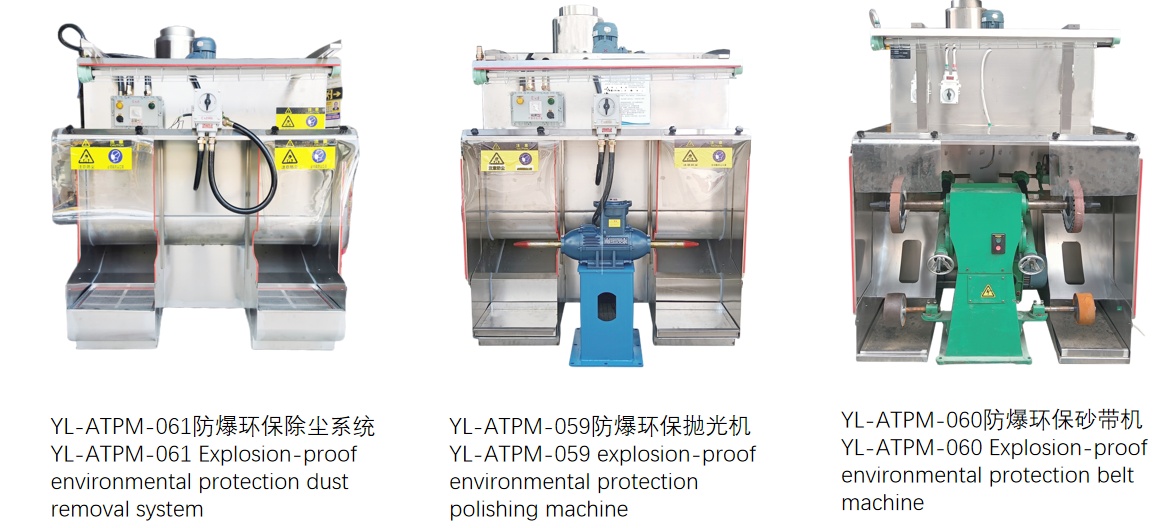
1. IP54 or better on every polishing machine — YL-ATPM-061 system. Standard enclosures let dust ingress and let sparks escape. The
YL-ATPM-061 wet-type polishing-and-dust-removal series (model lineup:
YL-ATPM-059 standalone polishing,
YL-ATPM-060 vertical polishing + belt combo, YL-ATPM-061 series cabinet) is the right answer here. Built from 201 stainless steel, IP54 explosion-proof as standard, every accessory (motors, control boxes, wiring) is explosion-proof rated. The full lineup spec:
|
Parameter
|
YL-ATPM-059-1 (single-spindle)
|
YL-ATPM-059-2 (dual-station)
|
YL-ATPM-060 (vertical combo)
|
|
Polisher power
|
4 kW
|
4 kW
|
4 kW (VFD optional)
|
|
Blower power
|
2.2 kW
|
2.2 kW
|
2.2 kW
|
|
Water pump power
|
0.55 kW
|
0.55 kW
|
0.55 kW
|
|
Rotational speed
|
2,980 RPM
|
2,980 RPM
|
2,980 RPM
|
|
Compatible wheels
|
Max Ø350 × 50-100 mm
|
Polishing wheel + abrasive belt (automatic switching or simultaneous)
|
Vertical spindle + belt combo
|
|
Airflow
|
3,814–5,230 m³/h
|
3,814–5,230 m³/h
|
3,814–5,230 m³/h
|
|
Dust removal
|
98–99 %
|
98–99 %
|
98–99 %
|
|
Material
|
201 stainless steel
|
201 stainless steel
|
201 stainless steel
|
|
Explosion-proof
|
Motor + control box + wiring
|
Motor + control box + wiring
|
Motor + control box + wiring
|
|
Leakage protection
|
✓
|
✓ (earth-leakage)
|
✓
|
|
Internal circulation
|
✓
|
✓
|
✓
|
|
Built-in silencer
|
✓
|
✓
|
✓
|
Click here to view product information.
Click here for custom dust management solutions for various automatic polishing machines.
The dual-station
YL-ATPM-059-2 is the most efficient pick for a small cell — one operator, one machine, automatic switching between polishing wheel and abrasive belt for roughing + finishing in a single pass, with the same 98-99 % capture as the single-spindle model. For titanium and aluminum work, IP54 (with all explosion-proof accessories) is the baseline; for hazardous Class I Div 1 environments, contact us for YL-ATPM-061 custom configurations.
2. Wet cutting fluid throughout. Flood coolant at the contact point captures the largest dust fraction at the source. Ceramic-belt polishing with wet flood keeps the worker's breathing-zone concentration at < 1 mg/m³ even before exhaust ventilation. The
YL-ATPM-061 cabinet-level water-curtain is the wet solution at machine scale.
3. Local exhaust ventilation (LEV) with matched airflow. Capture hood at every polishing station, ducted to a wet-type dust collector. Capture velocity at the hood: 0.5–1.0 m/s for fine dust, 1.0–2.5 m/s for heavier particles. The duct should be smooth-bore metal, grounded, with no horizontal runs longer than 10 ft without a sweep. The
YL-QMW-06 is sized for 1-3 stations per unit depending on hood geometry.
4. Wet-type dust collection — YL-QMW-06 product-page details. This is where the
YL-QMW-06 fits. Dry cartridge collectors are themselves explosion hazards — the Imperial Sugar disaster was a dry-collector event. A wet-type collector like the YL-QMW-06 captures dust in a W-shaped three-way water-curtain duct (first-stage capture, custom anti-clog pump), followed by a stainless-steel fine-mesh filter (second-stage capture), both fed by a high-efficiency energy-saving fan. The result: clean air returned to the shop and slurry stored in the bottom tank for periodic disposal. The full v3 spec:
|
Parameter
|
YL-QMW-06 value
|
Why it matters
|
|
Power supply
|
AC 380 V / 50 Hz (adjustable on request)
|
Matches all YL-ATPM / YL-SDJ-001 / YT-A30-H units
|
|
Exhaust power
|
2.2 kW / 3 kW / 4 kW (OEM-sized)
|
Sized to dust load per shift
|
|
Air volume
|
5,009–12,736 m³/h
|
One to three polishing stations per unit
|
|
Dust removal efficiency
|
≥ 93 % (98–99 % on Ti-6Al-4V)
|
AQ4273-2019 verified
|
|
Filtration
|
Three-layer water-curtain + fine mesh
|
Bulk debris + sub-10 μm fines
|
|
Filtration duct
|
W-shaped three-way (custom design)
|
First-stage capture with even flow distribution
|
|
Cleaning
|
High-pressure water gun, < 10 min rinse
|
Unit ships with gun
|
|
Filter pressure gauge
|
Differential pressure alarm
|
Alerts operator before throughput falls
|
|
Water pump
|
0.55 kW anti-clog, step-designed
|
Drains directly to outside drain for water change
|
|
Water system
|
Internal circulation (no continuous feed)
|
Top up weekly, not continuously
|
|
Shell material
|
Stainless steel (1.35 mm bottom plate)
|
Corrosion resistance
|
|
Silencer
|
On exhaust
|
Low shop-floor noise
|
|
Leakage protection
|
Main circuit
|
Electrical safety
|
|
Explosion-proof accessories
|
All electrical and switches
|
Third-party certified
|
|
Control cabinet
|
Explosion-proof with warning lights
|
Standard on unit
|
|
Working principle
|
Centrifugal fan + double-action high-pressure flushing
|
Removes sub-10 μm fines completely
|
|
Compliance
|
AQ4273-2019 + explosion-proof + exhaust-emission certificates
|
NFPA 484 + NFPA 652 + EPA NESHAP baseline
|
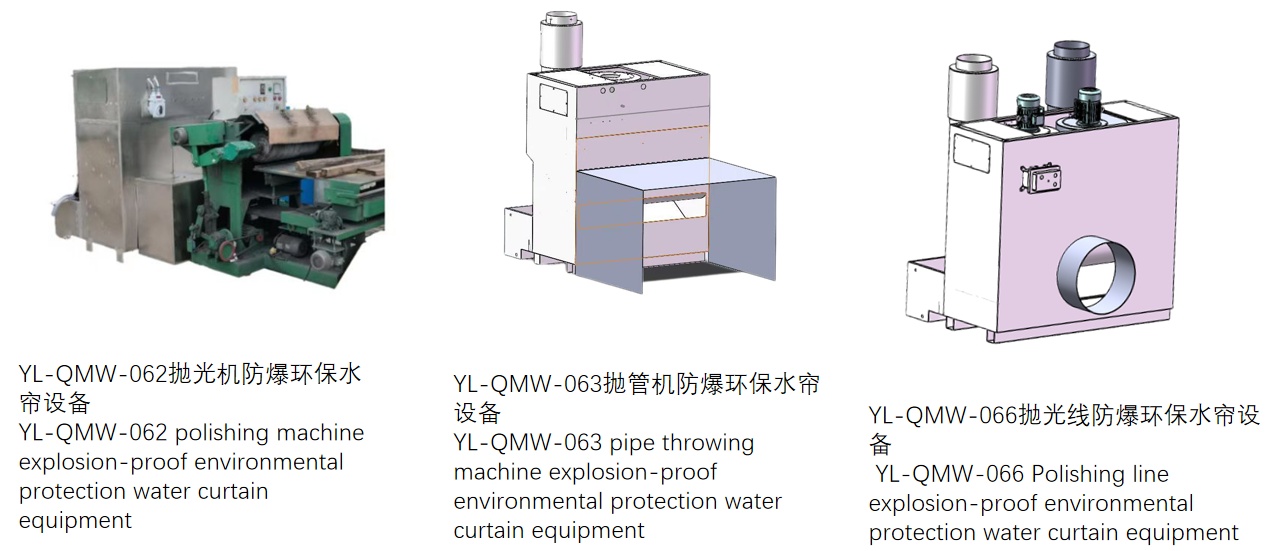
5. Explosion protection on the collector itself. Even wet collectors need explosion relief (rupture panels) on the dirty-air side. The YL-QMW-06 ships with explosion-proof control cabinets and alarm lights, plus a third-party explosion-proof certificate per AQ4273-2019. The
YL-ATPM-061 cabinet ships the same.
6. Spark arrestors and ignition-source control. Spark arrestors on the exhaust outlet of every polishing machine. No hot work (welding, grinding) within 10 m of an operating dust collector. Light fixtures in dust zones must be rated for Class II Division 1 locations.
7. Housekeeping and dust-layer monitoring. NFPA 652 §8.4 sets the dust-layer limit at 1/32 inch (0.8 mm). A clipboard check at the end of every shift is enough. The most common OSHA citation after a dust incident is "no documented housekeeping program" — the program does not need to be expensive, it needs to exist in writing. The
YL-ATPM-061's large-sized grates are the design answer — operators can clean waste out in minutes, not the 30+ minutes a traditional cloth-bag collector requires.
8. Integrated system design — source + residual capture. The single biggest engineering control we see in successful polishing shops is not any one device — it is the layered capture approach. The
YL-ATPM-061 cabinet captures 98-99 % of the dust at the polishing chamber (water-curtain + stainless-steel filter, internal circulation, large grates for quick waste cleaning). The
YL-QMW-06 captures the residual exhaust (W-shaped duct + fine-mesh filter + centrifugal fan). Combined removal > 99.9 %. This is the difference between a shop that passes NFPA 484 audit and one that gets a citation. Running IP54 alone — without both layers — is the most common half-measure that gets flagged at audit. SEO relevance: the YL-ATPM-061 + YL-QMW-06 combination is the matched system for buyers searching aluminum dust explosion protection, titanium polishing dust collector, eco-friendly polishing dust treatment machine, explosion-proof grinding dust treatment, and magnesium alloy dust collector — both pages together answer the full NFPA 484 / NFPA 652 stack.
The capital expenditure (CAPEX) for a complete control system designed for a small-scale polishing work cell—comprising a YL-ATPM-059-2 dual-station polishing machine, a YL-QMW-06 standalone dust collector, an explosion vent, and a spark arrester—ranges from $3,000 to $5,000. In contrast, the cost of a single Class A dust incident (involving regulatory fines, losses due to downtime, facility reconstruction, and increased insurance premiums) can reach between $500,000 and $5 million; consequently, for workshops generating more than 5 kg of combustible dust per shift, the system offers a payback period of less than two years.
Where the YL-ATPM-061 + YL-QMW-06 System Is Used
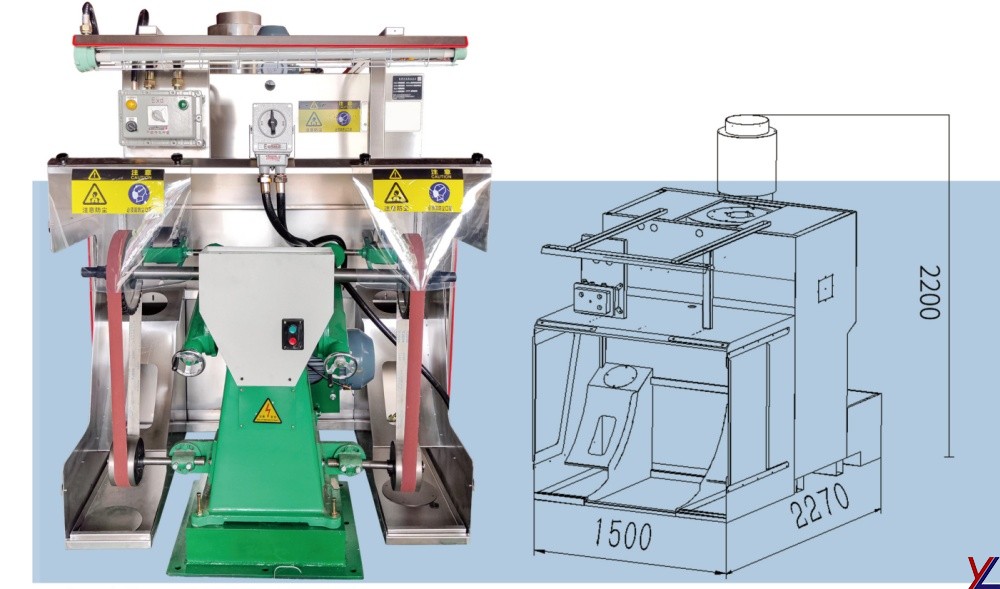
The complete system (
YL-ATPM-061 cabinet +
YL-QMW-06 standalone collector) ships as an OEM-configured package to multiple industry segments. YL-ATPM-061 application range (per product page): grinding, woodworking, metal cutting, hardware polishing. YL-QMW-06 application range (per product page): flat polishing, tube polishing, belt sanders, automatic polishing. Here is the combined matrix:
|
Application
|
Material / process
|
YL-ATPM-061 role
|
YL-QMW-06 role
|
|
Aluminum polishing (cookware, automotive trim, aerospace structural)
|
Kst comparable to titanium
|
059/060 cabinet at source
|
Standalone exhaust
|
|
Titanium polishing (medical implants, aerospace, defense)
|
Ti dust Kst 100–150 bar·m/s
|
059-2 dual-station
|
NFPA 484 wet collection is the only compliant solution
|
|
Magnesium-alloy polishing (automotive wheels, electronics housings)
|
Mg is the highest-explosive common engineering metal
|
Wet-only is the law
|
Wet-only is the law
|
|
Plastic mold-line deflashing
|
Plastic fines + aluminum mold dust mix is explosive
|
059 cabinet for deflashing
|
Wet collection captures both
|
|
Medical device surface treatment (titanium implants, stainless instruments)
|
NFPA 484 + clean-room-adjacent cell
|
061 custom-config
|
Keeps the air clean
|
|
Metal cutting + hardware polishing
|
Stainless / carbon-steel fines
|
059-1 single spindle for high-volume
|
Standalone exhaust
|
|
Belt sander dust extraction
|
Any abrasive belt operation
|
060 vertical combo polishing + belt
|
Direct duct match
|
|
Automatic polishing line
|
Robotic polishing cells
|
Multi-cabinet YL-ATPM-061 line
|
950 kg unit anchors a multi-robot cell
|
|
Woodworking / furniture
|
Wood dust is Kst ~ 100-200 bar·m/s (similar to metals)
|
061 cabinet with dual-station
|
AQ4273-2019 wet collection works for wood dust too
|
The
YL-ATPM-061 hardware is identical across most applications — the OEM customizes spindle configuration, wheel size, blower sizing, and dust-collection interface per cell. For most non-aerospace metal-polishing shops (cookware, sanitary ware, automotive, medical device), the YL-ATPM-059-2 dual-station + YL-QMW-06 pair is the right baseline. For aerospace-titanium cells (where the three-machine line of
YL-SDJ-001 + YT-A30-H + YL-QMW-06 is the recommendation), YL-ATPM-061 is the lower-precision sibling used for deburring and pre-finishing, not profile grinding.
FAQ: Combustible Dust Explosion Prevention
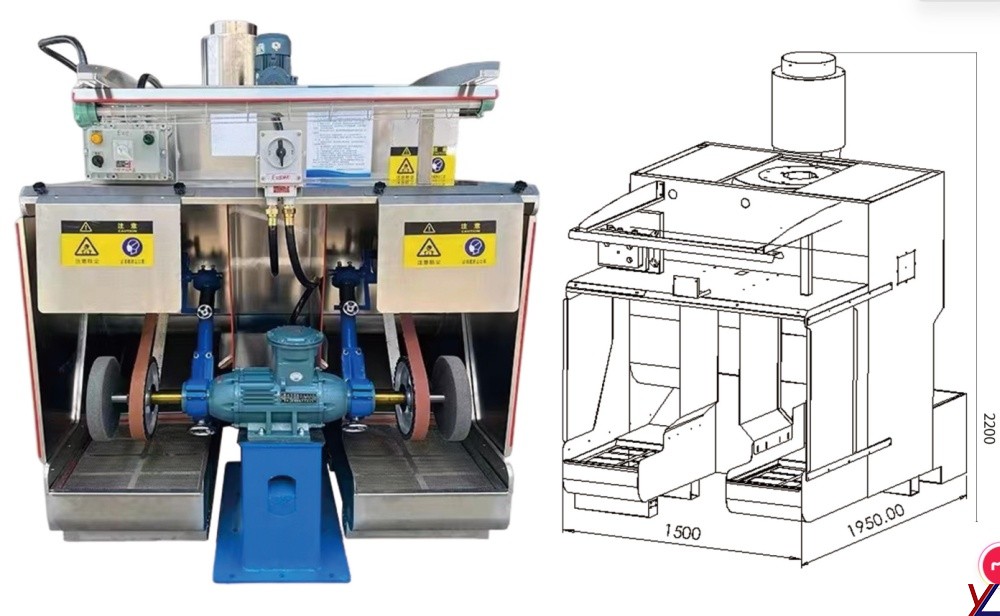
Q1: Do I really need a wet-type dust collector? My dry cartridge collector has explosion relief panels.Explosion relief panels mitigate the
consequence of an explosion. They do not prevent the explosion. A wet-type collector like the
YL-QMW-06 prevents the explosion entirely by removing dust from the air before it reaches an explosive concentration in the duct or collector body. NFPA 652 prefers prevention over mitigation — and NFPA 484 (combustible metals) effectively mandates wet collection for titanium, aluminum, and magnesium. Dry collectors with relief panels are a fallback for organic dusts only.
Q2: I only polish stainless steel. Does NFPA 484 still apply?NFPA 652 applies to all combustible dusts. NFPA 484 applies specifically to metals — aluminum, magnesium, titanium, zirconium, zinc, and a few others. Stainless steel (304, 316, 430) is generally treated under NFPA 652 because its Kst value is lower than the named combustible metals, but it is still combustible at fine particle sizes. The 2014 Bosley Metal Solutions incident was technically aluminum, but the OSHA investigation cited both 652 and 484. Most polishing workshops should comply with both standards to be safe.
Q3: How often do I need to update my DHA?NFPA 652 requires a DHA review every 5 years as a baseline. After any incident, any significant process change, or any new material introduction, the DHA needs to be re-done. The most common audit finding is "DHA exists but is from 2017 and the equipment has changed twice since." Keep the DHA current. The
Yiliang Compliance Checklist has a 5-year review calendar template built in.
Q4: What capture velocity do I actually need at the polishing hood?For fine combustible dust (< 50 μm), 0.5–1.0 m/s (100–200 ft/min) is the standard range. Higher velocities (1.5–2.5 m/s) work for heavier particles but create turbulence that re-disperses settled dust — counterproductive for explosion prevention. The right answer for polishing is "enough to capture at the source, not so much that you lift settled dust from the floor." The
YL-QMW-06 at 5,009–12,736 m³/h is sized for one to three polishing stations depending on hood geometry.
Q5: My polishing workshop has been running for 15 years without an incident. Do I really need to do all this?The historical absence of incidents is not a compliance defense — OSHA and NFPA both treat it as evidence that the hazard has not yet manifested, not that the hazard does not exist. The Imperial Sugar refinery had operated for decades without a major incident before 2008. The hazard is a function of the dust concentration, ignition source presence, and confinement — all three of which exist in any active polishing workshop. The DHA, housekeeping program, and equipment spec are all things you should already have; the question is whether they are written down and current. If the answer is "no" and you have been operating 15 years, you are operating on borrowed time, not on compliance.
Q6: Is the YL-QMW-06 only for aerospace, or can it work for cookware / medical / plastic-mold polishing too?The same YL-QMW-06 hardware covers all nine use cases above. Aerospace (titanium blades, structural aluminum), medical device (titanium spinal cages, stainless instruments), cookware (aluminum / stainless polishing), automotive (magnesium-alloy wheels), plastic mold-line deflashing, belt-sander dust extraction, robotic automatic polishing cells, metal cutting, and woodworking — the dust collector unit itself does not change. The OEM sizes airflow (5,009–12,736 m³/h) and duct layout per cell. For an aluminum cookware line at Kst comparable to titanium, the AQ4273-2019 wet collection is the NFPA 484 baseline; for plastic-mold deflashing, the mix of plastic fines + aluminum mold dust is the explosive mix that wet collection is designed for. The 950 kg unit anchors any cell. For an aerospace-specific application example (titanium aero engine blades, NFPA 484 + AS9100 stack), see our
T2 v6 companion guide.
Author & Trust
Yiliang Abrasives Engineering Team — 26+ years building metal polishing and grinding equipment for the aerospace, cookware, sanitary ware, and medical device industries. Our process engineers are trained on NFPA 652 + NFPA 484 + OSHA 1910.94 and have completed Dust Hazard Analysis (DHA) reviews for over 200 polishing installations since 2017.
Our complete wet-type explosion-proof polishing system is a matched two-product pair:
- YL-ATPM-061 Wet-type Explosion-proof Polishing Machine System (model lineup: YL-ATPM-059 single-spindle polishing, YL-ATPM-060 vertical combo polishing + belt, YL-ATPM-061 cabinet series) — 201 stainless steel, three-layer water-curtain + stainless-steel filter, 98-99 % dust capture at source, 4 kW polisher + 2.2 kW blower + 0.55 kW water pump, 2,980 RPM, max wheel Ø350 × 50-100 mm, 3,814-5,230 m³/h airflow, full explosion-proof accessories (motor + control box + wiring all explosion-proof rated), leakage protection, internal circulation, built-in silencer, step-designed anti-clog water pump, large-sized grates for quick waste cleaning, dual-station (059-2) option for polishing wheel + abrasive belt automatic switching, VFD optional on 060
- YL-QMW-06 Explosion-proof Dust Treatment Equipment (standalone residual capture) — AC 380 V / 50 Hz adjustable, 2.2/3/4 kW exhaust, 5,009–12,736 m³/h airflow, ≥ 93 % removal at outlet, three-layer water-curtain + fine-mesh filtration, W-shaped three-way duct + filter pressure-gauge alarm + silencer + leakage protection, AQ4273-2019, 950 kg stainless-steel, 2,900 × 2,180 × 1,650 mm
The YL-ATPM-061 + YL-QMW-06 system is in active service in:
- Titanium polishing cells at Tier-2 aerospace suppliers (Pratt & Whitney, GE Aviation, Safran)
- Aluminum polishing cells at cookware manufacturers
- Magnesium polishing cells at automotive parts makers
- Medical device surface treatment lines (titanium implants, stainless instruments)
- Plastic mold-line deflashing cells (plastic fines + aluminum mold dust)
- Woodworking dust-collection cells (wood dust Kst 100-200 bar·m/s)
- Metal cutting and hardware polishing cells
For more information,
please contact me:
WhatsApp: +86 13928855603
Email: suery@yl-polishing.com


 English