banner
Cases
Home Cases

Explosion-proof, eco-friendly dust-handling polishing machine

Explosion-proof, eco-friendly dust-handling polishing machine

July 23, 2026

Explosion-proof, eco-friendly dust-handling polishing machine


An eco-friendly dust-controlled polishing machine is a polishing system that captures and contains metal dust at the source, so the workshop stays clean, the operators stay healthy, and the surrounding air meets environmental regulations. The most common type uses a wet (water-curtain) filtration system with multi-stage filtration, achieving 95–99% dust capture at 1–10 µm particle size. Compared to a standard polishing machine with no dust control, an eco-friendly system typically pays back the cost premium in 12–18 months through reduced cleanup labor, lower PPE consumption, fewer health-related absences, and compliance with local environmental inspections.
 

What This Guide Covers

If you run a polishing workshop for hardware, sanitary ware, locks, eyeglass frames, or automotive parts, you have probably already felt the pressure from three directions at once:
  1. Environmental inspectors who now check workshop air quality
  2. Operators who complain about dust and respiratory irritation
  3. Buyers who will not accept parts shipped with embedded grinding residue
This guide explains what an eco-friendly dust-controlled polishing machine actually is, how it differs from a "regular" polishing machine with a hood, and what to look for when you buy one. If you are also evaluating systems against NFPA 652 or ATEX standards, see our companion guide on explosion-proof polishing equipment.


1. What Is an Eco-Friendly Dust-Controlled Polishing Machine?

The term covers any polishing system designed to contain dust at the source rather than let it escape into the workshop. In practice, three technical approaches exist, and they are not equal.
Type
How it works
Capture efficiency
Best for
Wet (water curtain)
Dust drawn through water, wetted, settled in tank
95–99%
Aluminum, magnesium, stainless, mixed metals
Dry (cyclone + cartridge filter)
Dust drawn through cartridge, collected in bin
90–95%
Iron, steel, non-combustible metals only
Hood only (no filtration)
Dust captured in a hood, vented outdoors
30–50%
Workshops with separate dust room (rare)
Why wet dominates the eco-friendly category in 2026:
  • Higher capture efficiency, especially for sub-10 µm particles
  • No fine dust blown back into the workshop during filter cleaning
  • No outdoor exhaust to upset neighbors or environmental inspectors
  • Filter media (water) is cheaper and easier to source than HEPA cartridges
For most B2B hardware and sanitary workshops polishing aluminum or stainless, a wet-type integrated polishing machine is the default eco-friendly choice.
 

2. Why "Eco-Friendly" Is No Longer Optional

Three forces are pushing workshops toward dust-controlled equipment, regardless of whether regulators have arrived yet.

2.1 Environmental compliance

In 2026, most manufacturing regions (China, EU, US, Southeast Asia) have specific air-quality standards for workshops that generate metal dust. A standard polishing machine without integrated dust control cannot meet them. Penalties range from warning letters to production-stop orders to per-day fines.

2.2 Operator health

Metal dust under 10 µm is respirable. Long-term exposure is linked to:
  • Aluminum: aluminosis, neurotoxicity
  • Stainless (especially with Cr/Ni): occupational asthma, increased cancer risk
  • Iron: siderosis
  • Mixed dust: chronic bronchitis
A wet dust-controlled system reduces respirable dust at the operator position to near-background levels.
 

2.3 Product quality

Dust that escapes the polishing station lands on the next part. For decorative hardware, sanitary ware, and parts going into plating, embedded dust causes:
  • Plating blister and peeling
  • Coating fish-eyes
  • Customer rejection at incoming QC
Capturing dust at the polishing machine fixes all three.
 

3. The 4 Core Specs of a Good Eco-Friendly Polishing Machine

A workshop owner who is not an engineer tends to compare prices and horsepower. The four specs below matter more for total cost of ownership.

Spec 1: Capture efficiency at the actual dust you generate

Ask the supplier for a measured efficiency number, not a marketing claim. The right metric is capture at 1–10 µm particles, because that is the respirable and explosive range.
  • < 90% at <10 µm: not adequate for compliance
  • 90–95%: passes most regional environmental standards
  • 95–99%: the gold standard for aluminum and stainless

Spec 2: Filtration stages (for wet systems)

A single-stage water curtain catches large chips but lets fine dust through. Multi-stage filtration is what separates a real eco-friendly system from a cheap imitation.
Stages
What it does
Acceptable for
1 stage
Large chips only
Pre-filtration only, not compliant
2 stages
Large + medium dust
Some regional standards
3 stages (water curtain + non-woven filter + water seal)
Large + medium + fine dust
EU / US / strictest CN standards


Eco-friendly, Explosion-proof Polishing Dust Collector


Spec 3: Filter media material

The filter is what stops the dust from re-entering the air. Two material choices:
  • Plastic / nylon mesh — common in low-cost machines, but is itself a fire hazard if a spark reaches it
  • Stainless steel screen — fireproof, lasts 5–10x longer, easier to clean with a water gun
For any aluminum or magnesium polishing, stainless steel filter is non-negotiable.

Spec 4: Water circulation design

Wet systems need water. The question is how much.
  • Open-loop (continuous fresh water in, drain out): high water use, often violates local water-discharge rules
  • Internal circulation (recirculate, change water on a schedule): 3–5 kg/h water use, drains only on water-change days
Internal circulation is the eco-friendly standard in 2026.
 

4. Wet vs. Dry: Which One for Your Workshop?

Consideration
Wet (water curtain)
Dry (cyclone + cartridge)
Best for materials
Aluminum, Mg, Ti, stainless, mixed
Iron, steel only
Capture efficiency
95–99%
90–95%
Floor space
Small (integrated cabinet)
Large (cyclone + duct + filter unit)
Water usage
3–5 kg/h
None
Filter replacement
Water change + screen clean (daily)
Cartridge every 3–6 months
Outdoor exhaust
None
Yes, requires permits
Insurance / regulatory acceptance
Standard
Conditional, requires DHA in many regions
Upfront cost vs. standard machine
+30–60%
+20–40%
Rule of thumb: If you polish anything that includes aluminum, magnesium, or titanium, choose wet. If you polish only iron/steel and have outdoor exhaust permits, dry can work, but the cost gap is small enough that wet is usually the simpler answer.
 

5. What a Good Eco-Friendly System Looks Like in Practice

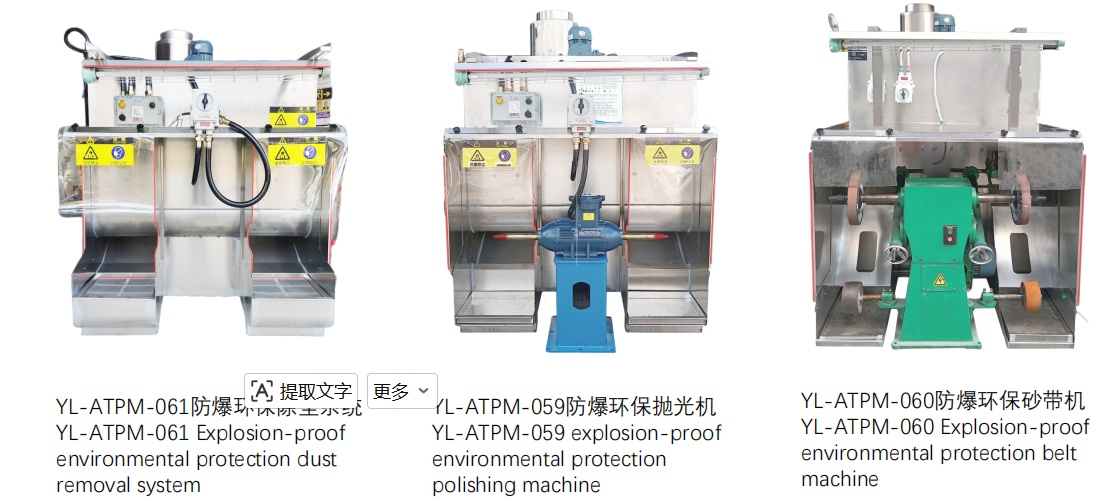
Below is a reference configuration based on our YL-ATPM-059, an integrated wet-type eco-friendly polishing machine designed for hardware, sanitary, and auto parts workshops.
Working principle:
  1. The polishing contact wheel generates metal dust at the source
  2. A dust hood within 50 mm of the contact wheel captures dust immediately
  3. A fan pulls dust-laden air through a 3-stage water-curtain filtration system
  4. Stage 1: bulk water curtain catches chips and large particles
  5. Stage 2: non-woven pre-filter catches medium particles
  6. Stage 3: stainless-steel screen + final water seal catches sub-10 µm fines
  7. Cleaned air exits the cabinet; settled dust is collected in the water tank for daily removal
Key design features (what to look for in any supplier's quote):
  • 3-stage water curtain — minimum for aluminum polishing
  • Stainless steel filter screen — not plastic mesh
  • Internal water circulation — low water consumption, easy drain
  • Built-in silencer — keeps workshop noise under 80 dB
  • Leakage protection (RCD) on the power line
  • Float-valve automatic water fill — no manual top-up
  • Removable debris grating — for fast daily cleaning


Specifications (model YL-ATPM-059):
Parameter
Value
Air volume
3,814–5,230 m³/h
Inlet wind speed
12–16 m/s
Dust capture efficiency
95–99%
Equipment material
Stainless steel cabinet
Motor power
2.2 kW
Pump power
0.55 kW
Polishing machine power
5.5 kW
Polishing machine speed
1,840 r/min
Total power
8.25 kW
Water consumption
3 kg/h (internal circulation)
Equipment weight
380 kg
Equipment size
170 × 150 × 210 cm
The YL-ATPM-059 is part of a wet-type integrated polishing family that also includes:
  • YL-ATPM-060 — companion belt sander
  • YL-ATPM-061 — companion dust removal system
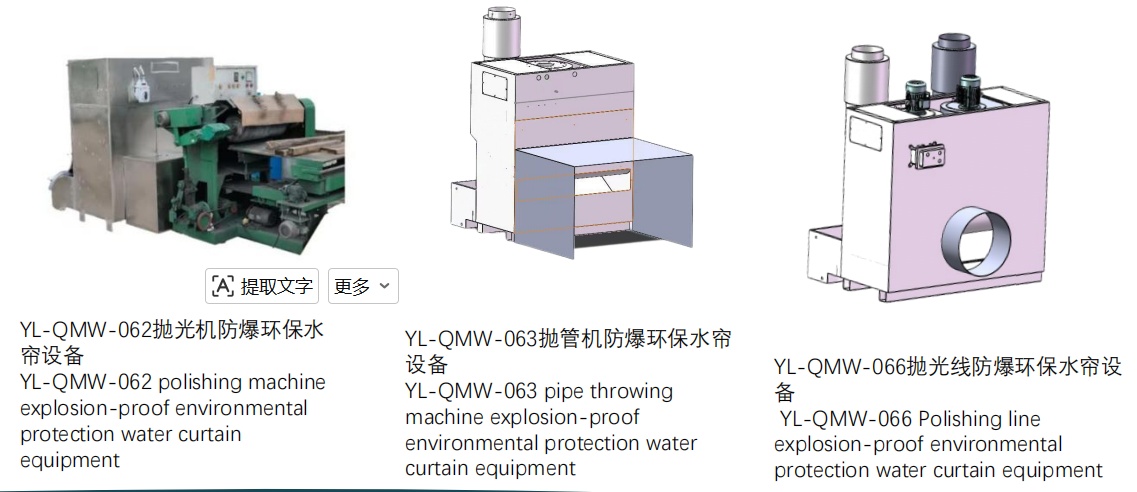
  • YL-QMW-062 / 063 / 066 — water-curtain equipment variants for pipe polishing and full polishing lines


6. Buyer's Checklist: 7 Questions for the Supplier

Before you sign a PO, ask the supplier these seven questions. If they cannot answer all of them, walk away.
  1. What is the measured capture efficiency at 1–10 µm particles? (Demand a test report.)
  2. How many filtration stages? (3 is the standard for aluminum. Anything less is non-compliant.)
  3. What is the filter media? (Stainless steel only. Reject plastic mesh for Al/Mg/Ti.)
  4. Is the water system open-loop or internal circulation? (Internal circulation for compliance.)
  5. Is the cabinet stainless steel? (Carbon steel rusts and contaminates the work area.)
  6. What is the noise level at the operator position? (Should be < 80 dB with built-in silencer.)
  7. Do you have reference installations in my industry? (Always ask for 1–2 cases you can call.)


7. Industry Applications

Eco-friendly dust-controlled polishing machines are now standard in:
  • Sanitary ware / bathroom hardware — high visual quality, zero dust embedding
  • Locks and door handles — aluminum and zinc die-cast, high volume
  • Metal eyeglass frames — titanium and stainless, fine dust control critical
  • Automotive and motorcycle parts — aluminum alloys, high throughput
  • Medical device metal components — strict cleanliness, no contamination
  • Cookware and kitchen utensils — stainless, food-safety requirements


FAQ

Q1: What is the difference between a polishing machine and an eco-friendly dust-controlled polishing machine?A standard polishing machine has no integrated dust capture — dust escapes into the workshop air. An eco-friendly dust-controlled polishing machine integrates a filtration system (usually wet water-curtain) at the source, capturing 95–99% of dust at 1–10 µm.
Q2: Do I need a wet or a dry dust collection system?Wet (water curtain) is the better choice for aluminum, magnesium, titanium, and stainless — and for any workshop that cannot exhaust dust outdoors. Dry cyclone + cartridge is acceptable only for iron/steel polishing with proper exhaust permits.
Q3: How much water does a wet system use?A well-designed internal-circulation system uses 3–5 kg/h. Water is changed on a schedule (typically daily or every shift), not continuously. An open-loop system that runs fresh water constantly uses 10–20x more and is not considered eco-friendly.
Q4: Will a wet system cause parts to rust after polishing?No, if the system is designed correctly. The dust hood captures dust at the source before it settles on the part, and the water curtain is contained inside the cabinet — it does not contact the workpiece. Stainless steel cabinet and proper airflow separation prevent any post-polishing moisture contact.
Q5: How often do I need to clean the filter?Daily: empty sediment from the water tank. Weekly: rinse the filter screen and check the fan. Monthly: open the maintenance door and clean the inner cavity with a high-pressure water gun. Filter screen replacement: only when damaged, typically once every 1–2 years.
Q6: Is a dust-controlled polishing machine more expensive to maintain?No. Daily maintenance is about 5 minutes (empty tank, visual check). Weekly cleaning is 15 minutes. The cost of water, filter screens, and pump wear is significantly lower than cartridge replacement on a dry system, and much lower than the labor cost of cleaning an uncontrolled workshop.


Talk to an Application Engineer

If you are specifying a new polishing line, replacing a non-compliant system, or responding to an environmental inspection, send us:
  • Material(s) being polished
  • Daily / monthly throughput
  • Current dust control setup (if any)
  • Local environmental standard you need to meet
We will respond with a recommended configuration, a sample test report, and a reference installation in your industry. Request a quote →

Published by Yiliang Abrasives — eco-friendly dust-controlled polishing machines and finishing consumables for OEM workshops. Since 2006. www.yl-polishing.com

Leave A Message

Leave A Message
If you are interested in our products and want to know more details,please leave a message here,we will reply you as soon as we can.

Home

Products

WhatsApp

contact